

CALL US TODAY
1-(844)-809-9990

Skip To:
A thermal scope is a rifle-mounted optic that detects heat rather than visible light, allowing you to see animals, people, and objects in complete darkness. Our thermal scope collection supports this guide by breaking down how a thermal scope works, how to choose the right one, and which features actually matter in real-world hunting and tactical scenarios.
This guide is for hunters, tactical professionals, and anyone interested in advanced optics technology. Thermal scopes have become essential tools for effective night hunting and tactical operations as traditional optics reach their limits.
The difference between thermal optics and a traditional scope becomes obvious the moment you’re standing in Texas mesquite at midnight. Your glass rifle scope shows nothing but darkness. A thermal riflescope reveals the heat signature of hogs moving through brush 200 yards out, each animal’s heat signature glowing against the cooler vegetation. All objects emit infrared energy proportional to their temperature, which thermal scopes detect using specialized lenses—and that capability changes everything about how you hunt after sunset.
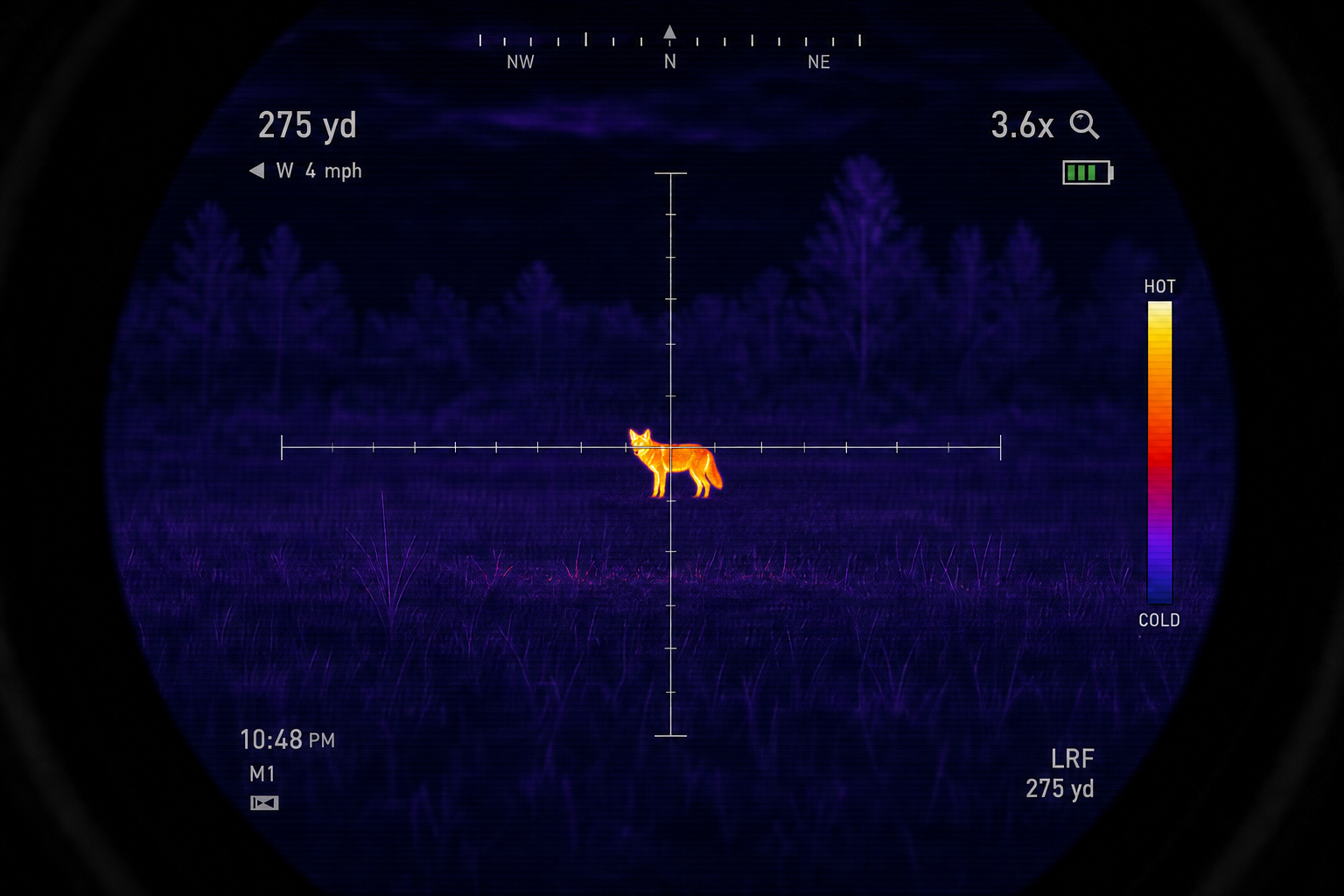
Thermal scopes convert infrared radiation into a digital image and display it using color palettes such as white hot, black hot, red hot, and fusion. The microbolometer in thermal scopes reacts to tiny changes in heat, creating an electrical signal that the processor renders into what you actually see. Processed data from thermal scopes is displayed as a heat map on AMOLED or OLED screens, giving you a clear picture of thermal contrast in your environment.
This guide from Proven Optic covers the fundamentals you need to understand before investing in thermal technology. In the future, we will link to in-depth pages covering specific topics such as the best thermal scope for hog hunting, thermal clip-ons vs. dedicated scopes, and model-by-model comparisons.
Proven Optic specializes exclusively in optics—hunting and tactical—with every product choice field-proven by hunters, law enforcement professionals, and Proven Justice investigators who depend on performance when it matters.
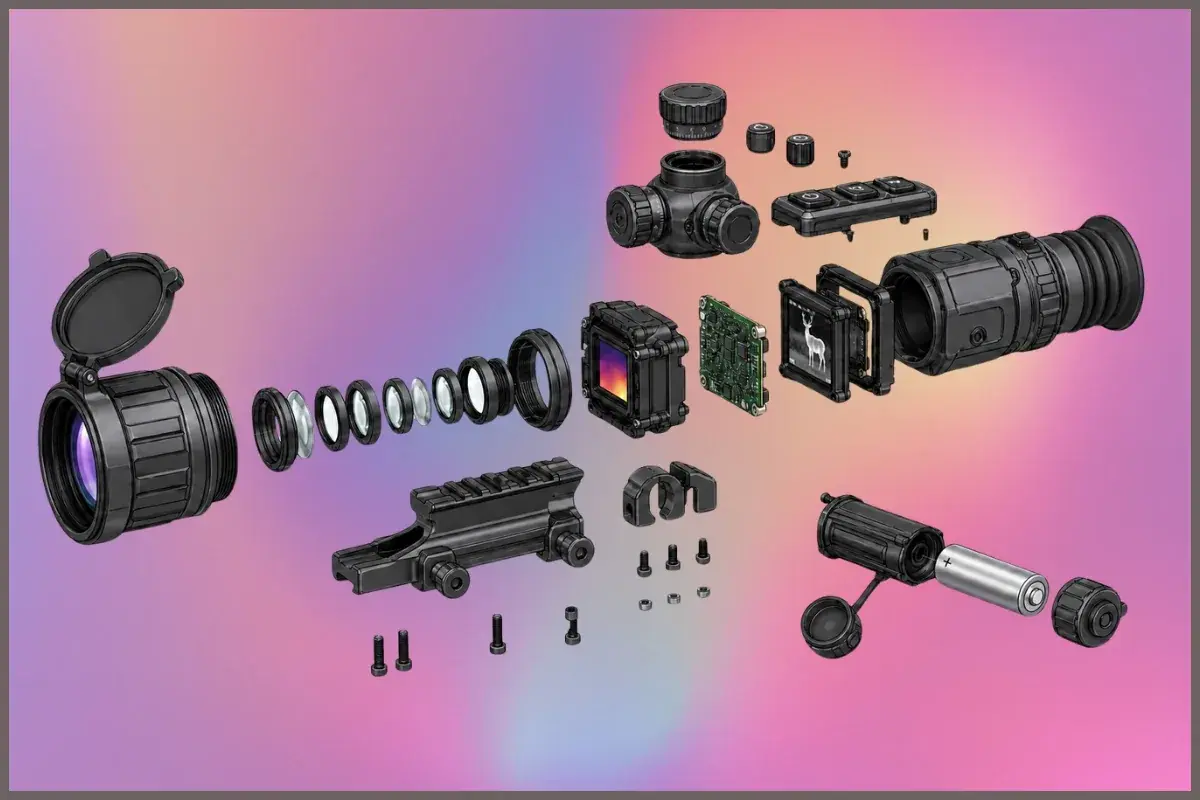
Understanding the basics helps you make smarter buying decisions without needing an engineering degree. Here’s the practical breakdown:
An uncooled VOx (Vanadium Oxide) microbolometer sensor sits behind the lens.
This thermal sensor detects temperature differences in your field of view.
Each pixel on the sensor reacts to infrared radiation by changing its electrical resistance.
That resistance change becomes an electronic signal representing heat distribution
Lens: Germanium or Zinc Selenide optics (not glass—glass blocks infrared)
Sensor: Converts infrared radiation to electrical signals
Processing: Noise reduction, sharpening, and contrast enhancement
Display: Renders the final thermal image you see through the eyepiece
|
Term |
What It Means |
Why It Matters |
|---|---|---|
|
Sensor Resolution |
Pixel count (256×192, 384×288, 640×512, 1280×1024) |
Higher resolutions improve clarity and detail |
|
Pixel Pitch |
Physical distance between pixels (10-17µm) |
A smaller pitch enables finer thermal discrimination |
|
NETD Sensitivity |
Noise Equivalent Temperature Difference (<25mK is excellent) |
Lower values indicate better detail in low-contrast scenes |
|
Refresh Rate |
How often the image updates (25Hz vs 50/60Hz) |
Higher frame rates ensure smoother images while tracking fast-moving targets. |
Picture a coyote at 275 yards on a cool March night. The animal’s 100.4°F body temperature creates a strong thermal contrast against the 41°F grass and soil. Your 640×512 sensor renders that contrast as a clearly defined silhouette. On a warm August evening, when ground temperatures reach 82°F, that same coyote presents less contrast—still detectable but requiring greater sensor sensitivity. Dive deeper into how thermal scopes work before you invest in this technology. Being informed will give you the best outcomes.
Thermal imaging differs fundamentally from night vision technology. Thermal imaging detects emitted heat; digital and analog night vision either amplifies ambient light or uses IR illuminators. Modern multispectral devices combine both approaches but represent a separate product category.
This comparison ranks among the most common questions from new buyers. Many questions can be answered with this decision framework:
|
Capability |
Thermal |
Night Vision |
|---|---|---|
|
Detection through light brush/fog |
Excellent |
Poor |
|
Works in complete darkness |
Yes (no illuminator needed) |
Requires ambient light or IR illuminator |
|
Detail and recognition at close range |
Good |
Excellent |
|
Navigation and movement |
Limited |
Excellent |
|
Daytime safe |
Yes |
Many models are damaged by bright light |
|
Reading text, ID plates |
No |
Yes (with sufficient light) |
Thermal dominates for hog hunting in tall grass across Texas and Oklahoma. The animals’ heat signatures punch through vegetation that would render night vision useless. Coyote hunters in Kansas wheat stubble see similar advantages—thermal detects predators moving through cover that obscures visible-light systems.
Night vision still excels for scanning trails, reading terrain features, and navigating to your stand without a flashlight. Many hunters use night vision for movement and transition to thermal for target acquisition.
Thermal provides superior capability for perimeter overwatch, suspect detection behind light cover, and vehicle interdiction. Thermal scopes provide a significant advantage in security applications, enabling police and security personnel to locate individuals in low-light or smoke-filled environments.
Night vision goggles remain essential for movement, driving without headlights, and team coordination, where facial recognition and hand signals matter.
Many serious operators run both technologies—a thermal riflescope or handheld thermal for detection and engagement, paired with helmet-mounted night vision for navigation. This combination mitigates each technology’s weaknesses.
Thermal riflescopes function as 24/7 devices, safe for daylight use without damage. Some night vision systems require protective caps and careful light management.
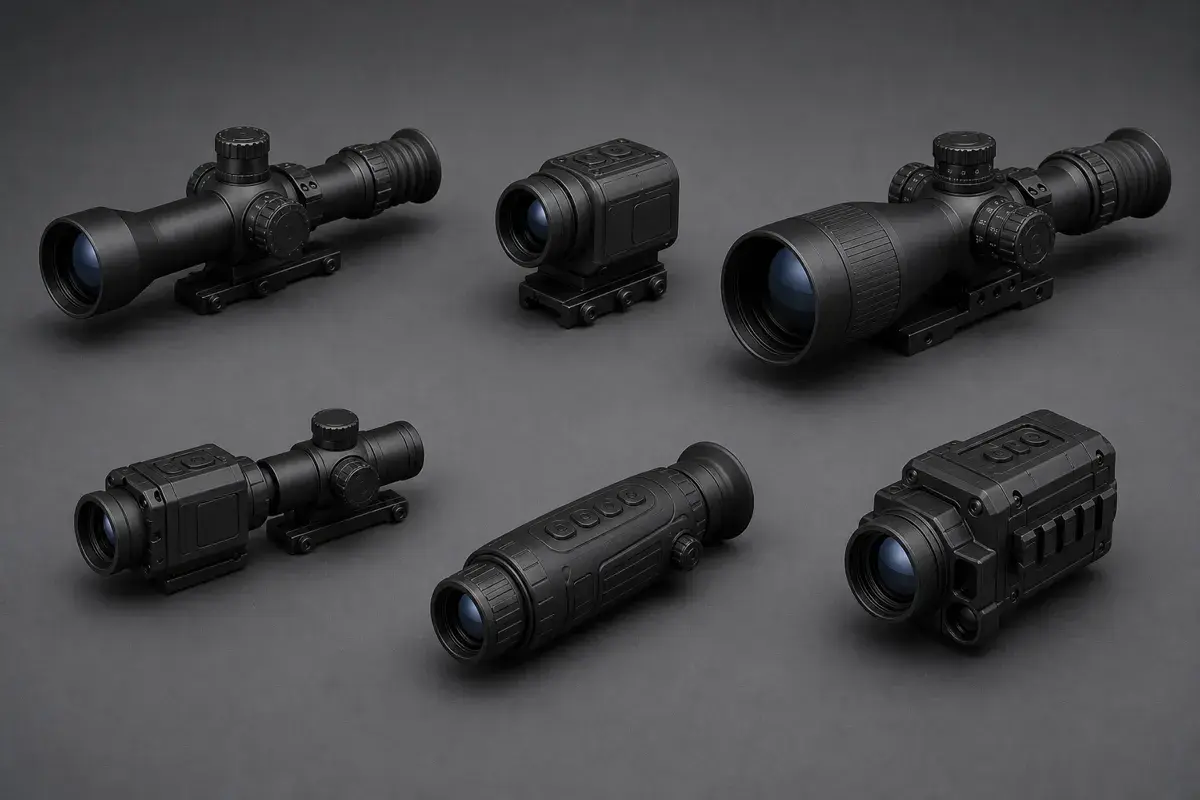
The thermal market includes several distinct product categories. Understanding each helps you build the right system for your mission.
Purpose-built aiming devices with integrated reticles, zeroing systems, and often ballistic tools. These mount directly to your rifle’s Picatinny rail as the primary sighting system. Ideal for hog, coyote, and predator hunting out to 400+ yards, depending on model and sensor resolution. Modern dedicated thermal scopes integrate features like laser rangefinders, onboard recording, and WiFi connectivity.
Front-of-scope attachments that convert an existing day optic into a thermal system without re-zeroing. You maintain your established zero on your precision rifle scope and simply flip the thermal unit in or out of the optical path. Popular with precision shooters and law enforcement who cannot compromise established zeros.
Handheld scanners for wide-area detection that reduce rifle fatigue during extended observation. Most hunters find these valuable for spotting targets before transitioning to a rifle scope for the shot. Lighter and more portable than weapon scopes.
Compact units are used for close-quarters work, tracking, or backup. Bridgeable monoculars can be mounted on helmets or transferred to rifles, depending on mission requirements.
Combined thermal and digital night-vision riflescopes that offer both technologies in a single housing. Proven Optic treats these as a related but distinct category—they serve users who need both capabilities without carrying separate devices.
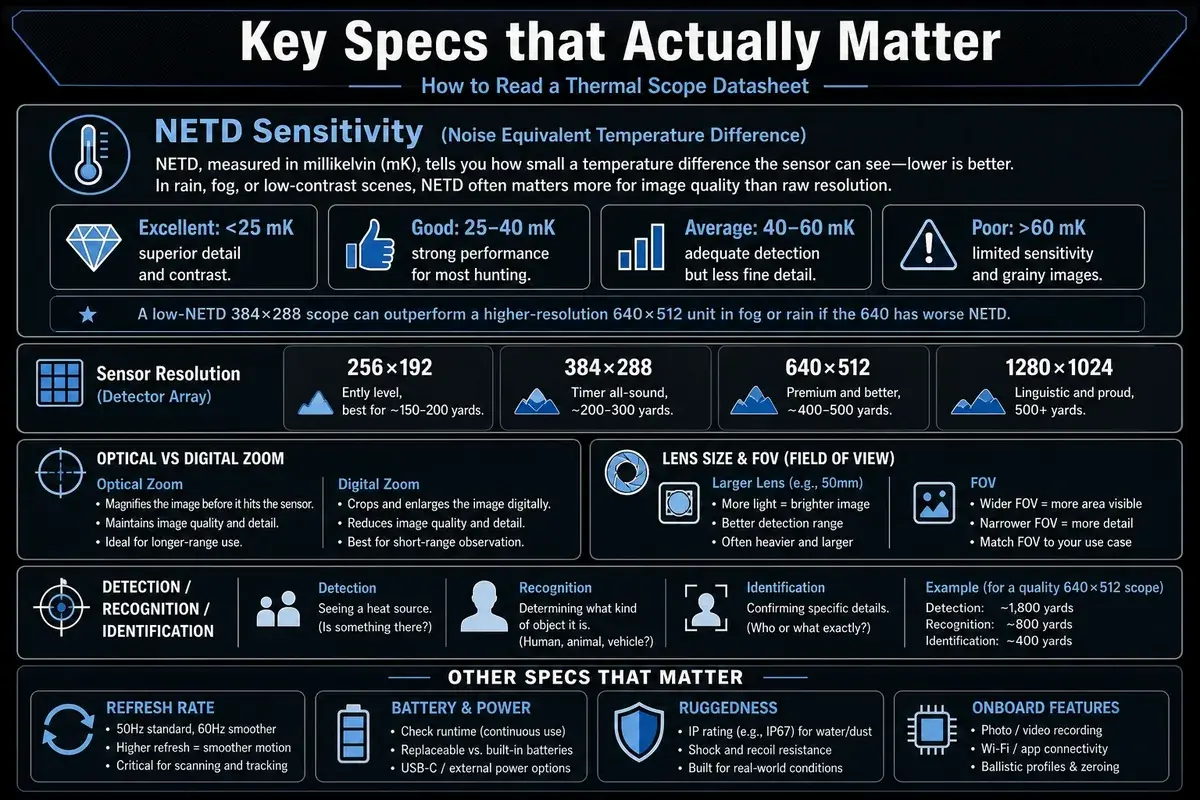
Spec sheets can intimidate new buyers. Some numbers genuinely affect field performance; others are primarily marketing. Here’s what moves the needle.
Noise Equivalent Temperature Difference (<25mK is excellent) measures the thermal scope's ability to detect small temperature differences. Lower NETD values indicate better sensitivity and finer detail in low-contrast scenes, allowing you to distinguish subtle heat variations for improved target identification, especially in challenging environments. For a full explanation of how NETD ratings affect image quality, weather performance, and real-world target detail, see our NETD thermal sensitivity guide for rifle scopes.
General NETD groups include:
Excellent: Below 25mK, offering superior detail and contrast
Good: Between 25mK and 40mK, suitable for most hunting and tactical uses
Average: Between 40mK and 60mK, adequate for basic detection but less detail
Poor: Above 60mK, limited sensitivity and image quality
As expert Astrotelescopium noted in March 2026, "NETD (sensor sensitivity) determines image quality more than resolution. A 384x288 sensor with <20mK NETD will outperform a 640x512 with >35mK NETD in rain or fog." This highlights the critical importance of sensor sensitivity over raw pixel count in adverse weather conditions.
256×192: Entry level. Adequate for short-range hogs under 150-200 yards, but limiting for species identification beyond that
384×288: Practical sweet spot for many East Coast hunters pursuing hogs and predators in timber within 200-300 yards
640×512: Premium clarity and identification capability. A 640×480 @ 12µm sensor is commonly found in thermal scopes and offers a strong balance of clarity and range for most hunters, effective up to 400-500 yards.
1280×1024: Flagship image quality seen in high-end units. The latest thermal optics technology features sensors with resolutions such as 640×480 and 1280×1024, which significantly enhance image clarity and target identification at long distances, typically 500 yards and beyond
Higher sensor resolutions improve the clarity and detail of thermal images, which is important for identifying targets at long distances. However, identifying heat signatures with thermal scopes usually still requires proximity, despite their impressive detection ranges. If you want to understand how resolution, pixel pitch, and NETD work together to create that real‑world performance, see our in‑depth thermal scope sensor guide.
Optical magnification (2x, 3x, 4x base) preserves sensor detail. Digital zoom simply enlarges pixels without adding information. A 2x digital zoom on a 640×512 scope remains usable for target ID; an 8x digital zoom on a 256×192 sensor becomes blocky and misleading. Treat digital zoom as a tool for fine aiming adjustments, not primary target recognition.
Larger objective lenses increase detection range and image quality for long-range use in thermal scopes.
25mm lens: Wide field of view (FOV) for close-quarters scanning in dense timber
35mm lens: Balanced for hogs inside 300 yards—adequate FOV with reasonable magnification
50mm lens: Optimized for open-country shooting and long-range shooting applications
Lens materials, coatings, f-numbers, shapes, focal lengths, and element designs all directly impact image quality and system performance. A well-designed lens can significantly improve a sensor's performance, while a poorly designed lens can limit even a high-quality sensor's capabilities. Because lens design plays a foundational role in thermal imaging performance, understanding these factors and their tradeoffs is important before making a purchase. Our complete guide to thermal scope lenses provides detailed information on these considerations.
Detection: Maximum distance to determine a target exists (human-sized targets: 1800+ yards on quality optics)
Recognition: Maximum distance to determine general target type (“that’s an animal, not a rock”)
Identification: Maximum distance to confirm species, angle, and shot placement suitability
A 640×512 scope might detect a human at 1800 yards, but only confidently ID a coyote at 400 yards.
25Hz scopes feel sluggish when panning or tracking running hogs. 50-60Hz displays provide noticeably smoother tracking for dedicated night hunting rigs.
Display resolution affects how clearly you see the thermal image, but it cannot create detail the sensor did not capture. For the best image, match a strong display with a good sensor, lens, NETD rating, and refresh rate.
OLED and AMOLED both deliver deep blacks and high contrast. Standard OLED remains a capable, value-focused option, but AMOLED utilizes an active matrix to offer faster response times, smoother motion, and more precise brightness control. You can see how these technologies perform side-by-side in our detailed AMOLED vs. OLED thermal scope guide.
Removable 18650 or 21700 lithium cells offer field-swappable convenience. Realistic battery life runs 6-10 hours, depending on brightness and processor load. Always carry spare batteries for all-night operations.
Thermal scopes should have an IP67 waterproof rating and high shock resistance for durability. Check recoil ratings for your caliber—a scope rated for .308 may not survive .338 Lapua punishment.
Integrated laser rangefinders, onboard ballistic calculators, WiFi connectivity, and recording capability add value for precision shooters. Some hunters prefer simpler interfaces with intuitive operation.
Understanding how different users deploy thermal technology helps you identify which features matter for your situation.
Thermal has revolutionized nocturnal predator control. In Texas and Oklahoma, thermal enables effective hog population management without disturbing diurnal hunting patterns. Coyote hunters across the Midwest exploit predator behavioral patterns during darkness. Thermal scopes excel in tracking wounded game by following residual heat trails—a capability traditional optics simply cannot match.
Higher-resolution sensors with quality glass support precision on coyotes at 400+ yards in low-light conditions. Prairie dog shooting near dusk benefits from thermal detection. However, thermal fine detail cannot match high-quality daylight glass for extremely small targets at extreme distances.
Perimeter security monitoring, suspect tracking in urban and rural environments, locating subjects in woodlines—thermal capability provides detection unavailable through other optical means. Thermal scopes are designed to operate effectively in extreme environmental conditions, including total darkness, fog, light rain, and smoke, where traditional optics may fail.
In search and rescue operations, thermal imaging scopes can quickly identify the thermal signatures of lost or stranded individuals, significantly enhancing rescue efforts. A handheld thermal monocular locates a lost hiker by body heat when flashlights and voice searches fail.
Thermal vision scopes are increasingly used in wildlife observation, allowing conservationists to track nocturnal or cold-blooded animals that are otherwise difficult to see.
Advanced thermal optics help reconstruct crime scenes at night, locate discarded evidence that retains heat signatures, and support surveillance operations. This connects Proven Optics purchases to real-world impact.
Rural landowners monitor livestock, detect predators threatening animals, and address invasive species like feral hogs and nutria.
When selecting a thermal scope, key factors to consider include image quality, range, sensor size, magnification, refresh rate, and durability, tailored to the intended use, such as hunting or tactical operations. To quickly match your specific field requirements to the exact spec. you need, use the selector tool for thermal scope specifications.
AR-15 carbines in 5.56/.223 accommodate lighter thermal riflescopes without balance issues. AR-10s in .308 and bolt guns in 6.5 Creedmoor require attention to recoil ratings and eye relief. Magnum calibers demand scopes rated for heavy recoil.
Thick Southern timber favors wider FOV and lower base magnification. Open Western wheat fields and prairies benefit from 50mm lenses and higher magnification. Mixed farmland falls between these extremes.
Decide whether to invest more in a thermal monocular for scanning plus a mid-priced rifle scope, or consolidate into a flagship thermal riflescope you’ll both scan and shoot with. Most hunters eventually prefer dedicated scanning and shooting devices.
Look for large focus rings and zoom wheels positioned similarly to a traditional scope. Cold-weather operations in the Dakotas demand controls that work with heavy gloves.
Leave headroom for future needs—longer ranges, recording for evidence, ballistic app integration. High-volume hunters and professionals benefit from buying capability they’ll grow into.
For a $3,000-$7,000+ purchase, warranty terms and real-world repair experience matter significantly. Pulsar’s US-based support has earned strong reviews in hunting communities, while other manufacturers vary in turnaround time and service quality—research brand-specific support before committing to a major investment.
Proven Optic product filters help you narrow choices by range, resolution, budget, and mounting type.
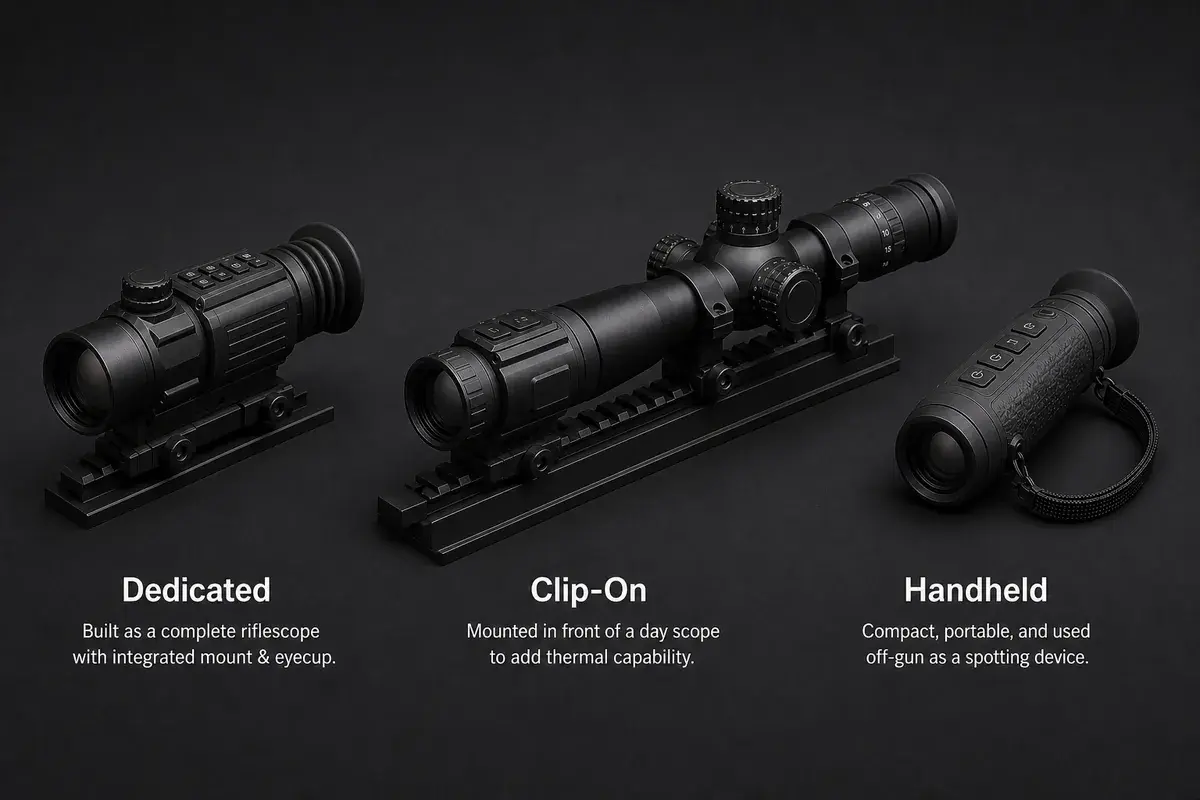
Both dedicated scopes and clip ons sell well at Proven Optic, and buyers often struggle to pick the right approach.
Cleaner interface without optical stacking
Lighter overall system weight
More integrated features (LRF, ballistics, recording)
No day-scope parallax concerns
Ideal for rifles built primarily for night hunting
Cannot instantly switch to glass for daylight competition
Requires a separate zero establishment
More expensive when covering multiple rifles
Maintains existing day-scope zero
Fast transition from day to night operation
Excellent for precision rifles already wearing premium glass
Ideal when you cannot remount scopes frequently
More complex optical stack with potential for slight image degradation
Heavier front-end balance
Generally, higher prices for comparable image quality
A Texas hog hunter with a dedicated .308 night rifle benefits from a dedicated thermal riflescope—purpose-built integration without compromise. A PRS competitor who occasionally shoots at night may prefer a quality clip on in front of their 5-25x day scope.
Picatinny rails offer standardized mounting; Weaver-format rails require compatible hardware or adapters. Ring sizing must match the scope tube diameter. Proper torque specs (typically 20-25 inch-pounds) prevent zero drift. For shooters pairing thermal with existing rifles, verify rail compatibility before purchase.
Many new buyers over-prioritize maximum magnification and undervalue the field of view. Balance matters more than extreme specifications.
1-4x: Wide FOV for close-quarters work and fast target acquisition in dense terrain
2-6x: All-around performer for mixed hunting scenarios
4-16x: Open-field and long-distance applications
High magnification in thermal scopes can be misleading; many hunters find that they operate effectively between 2x and 6x magnification, as image quality tends to degrade with excessive zoom.
A 2x digital zoom on a 640×512 scope remains practical for shot refinement. An 8x digital zoom on a 256×192 sensor produces blocky, unreliable imagery. Never rely on digital zoom as your primary identification tool.
A running sounder of hogs at 80 yards—wide FOV at 2x base magnification lets you track multiple animals and select your shot. A 6x base might show only one pig at a time, complicating target prioritization.
Many modern thermal optics offer a small magnified window while maintaining a wide FOV in the main display. This allows scanning and precision aiming simultaneously.
East-coast hogs and predators in timber: 2-3x base with 35mm lens. Western coyote hunting in open country: 3-4x base with 50mm lens for superior clarity at distance.
Image palettes, reticle options, and controls significantly affect speed and accuracy during night operations.
Color palettes used in thermal scopes include White Hot, Black Hot, Red Hot, and Fusion.
White Hot: Heat sources appear white/light gray. Preferred for extended sessions—reduces eye fatigue.
Black Hot: Inverse display. Some shooters prefer this for specific lighting conditions.
Red Hot: Heat appears in warm colors. Can speed target acquisition, but offers less contrast.
Rainbow/Ironbow: Full color spectrum showing temperature gradients. Excellent for environmental analysis
Multiple color palettes let you optimize for conditions and personal preference. Read Thermal Colors for Hunting and Tactical Optics to discover how to select and time the perfect color palette for your environment.
Common options include MIL/MOA graduated reticles, BDC (bullet drop compensator) patterns, and simple duplex styles. For hog and coyote hunting at typical ranges, clean, uncluttered reticles work best.
One-shot zero and freeze-frame functions simplify zeroing without firing multiple rounds. Practical zeroing often occurs during late afternoon when thermal contrast is favorable, and impacts can be verified.
Scopes with tactile buttons, rotary knobs, and zoom rings positioned similarly to traditional scopes support muscle memory. App-based fine-tuning adds capability but shouldn’t replace solid onboard controls.
Critical for recoil safety and comfort on .308 and heavier rifles. Extended night sessions demand comfortable eyecups.
These features separate basic detection tools from precision shooting systems.
Thermal images lack the depth cues present in visible-light optics. An integrated laser rangefinder eliminates range estimation guesswork for shots beyond \~200 yards, directly supporting ethical shot placement on coyotes at 350-450 yards.
Enter your rifle specifications—caliber, muzzle velocity, ballistic coefficient—and the onboard ballistic calculator computes holdover solutions automatically based on LRF data. Combined with ballistic data from environmental sensors, this integration substantially improves first-round hit probability.
Modern thermal scopes are increasingly equipped with advanced image-correcting software and features like onboard recording, multiple color palettes, and integrated laser rangefinders to enhance usability and performance in various conditions. App connectivity enables profile syncing, firmware updates, and footage downloads. Pain points include occasional dropped connections and learning curves.
Document hunts, review shot placement, and preserve evidence for tactical or investigative work. Premium models trigger recording automatically when the rifle fires.
Some next-generation optics mix thermal with digital night vision channels, offering PIP views combining both technologies. These represent emerging categories that Proven Optic actively evaluates.
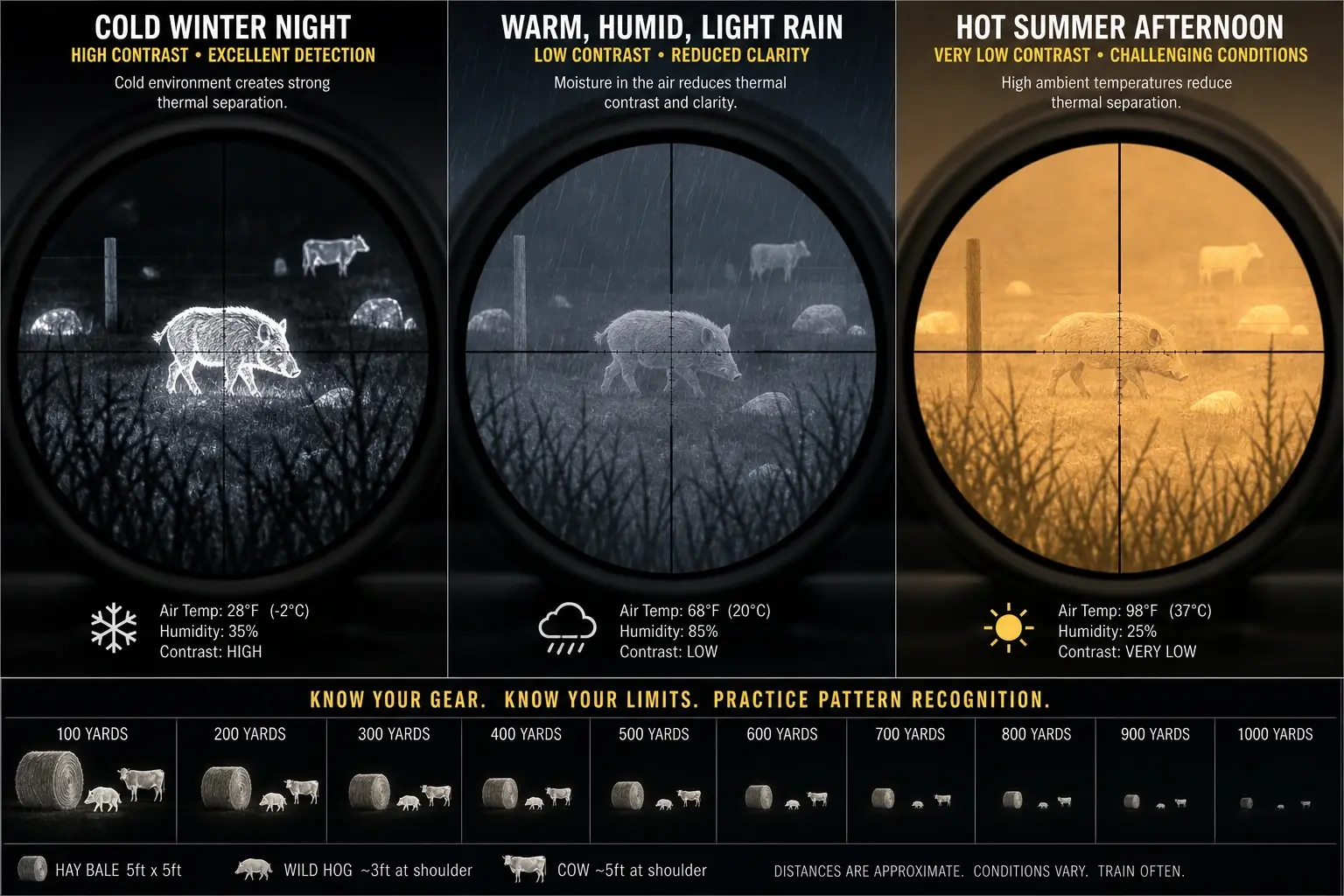
No thermal scope works magic. Performance depends on conditions, contrast, and user skill.
Humidity, heavy rain, and warm, windless nights reduce effective range and contrast. Clear cold winter nights produce crisp images with maximum detection capability. Thermal optics work efficiently during bright sunlight, revealing camouflaged animals that would blend into their surroundings otherwise, though afternoon summer heat reduces contrast as ambient and target temperatures converge.
Sun-warmed rocks, fence posts, and livestock create thermal signatures that compete with actual targets. Experience helps you interpret these signatures quickly. Hot backgrounds diminish contrast against warm-blooded targets.
Thermal cannot see “through” trees or thick brush—only around gaps and edges. Thermal scopes are limited to surface-level detection and cannot see through solid barriers like walls or water.
Scan hay bales, livestock, or decoys at known distances during dusk to learn how thermal signatures behave in your region. This practice builds pattern recognition that speeds target ID under hunting conditions.
Regulations vary by U.S. state and by country. Verify 2026 local laws before purchasing or deploying thermal scopes.
Legal restrictions on the use of thermal scopes for hunting vary significantly by state. Some states restrict night hunting with thermal to non-game species like hogs and coyotes; others prohibit it entirely for hunting purposes. Check your state wildlife agency for current rules.
Thermal enhances detection but doesn’t eliminate judgment requirements. Confirm species, angle, and background before pulling the trigger. Over-reliance on detection without proper identification leads to unethical outcomes.
Avoid scanning across property lines in populated areas. Semi-rural suburbs carry reasonable privacy expectations even at night.
While thermal assists investigations, evidence collection must follow agency policy and legal standards for courtroom admissibility.
Backstop awareness intensifies at night when you cannot visually confirm what lies beyond your target. Communication with hunting partners and use of visible/IR markers prevent dangerous situations.
Protecting a $1,500-$7,000+ investment requires attention to maintenance practices that differ from traditional optics.
Use quality mounts with proper torque specs (typically 20-25 inch-pounds). Consistent rail position and clean mounting surfaces minimize drift. Repeated removal/reinstall cycles suit high-end mounts and clip ons better than budget hardware.
Germanium lenses scratch more easily than glass. Use an air blower first, then microfiber cloth with appropriate solvents. Never use household glass cleaners. Scratched Germanium cannot be repaired—replacement costs $500-$2,000+.
Rotate labeled spare batteries. Avoid deep discharge in cold weather. Store lithium cells properly between seasons. Realistic battery life runs 6-10 hours; carry spares for all-night hunts.
Update when manufacturers release improvements for image processing or stability. Test changes before critical hunts or operations.
Many thermal scopes are built with rugged materials and are often rated for waterproofing and shock resistance, ensuring they can withstand harsh field conditions. The durability of thermal scopes is often enhanced by features such as gasketed compartments and robust chassis designs, which protect internal components from environmental damage. Store in padded weatherproof cases with silica gel packs. Avoid extreme heat like closed vehicles in summer—heat damages microbolometers and displays.
Understanding brand positioning helps you match manufacturer strengths to your priorities.
The AGM Adder V2-60 is recognized as the top thermal scope of the year, featuring a 1280-class sensor and a high-resolution 2560×2560 digital display, priced at $7,300. Recent advancements in thermal imaging include the integration of high-resolution displays, such as 2560×2560, which provide clearer and more detailed images compared to traditional thermal scopes. AGM represents the flagship tier for users demanding maximum resolution and advanced display technology.
The Pulsar Thermion 2 XL50 is noted for its excellent optics and image-enhancing software, making it a strong competitor in the thermal scope market. Pulsar has built strong brand loyalty through US-based customer support and consistent firmware updates. Their mid-to-premium tier offerings deliver superior clarity for committed night hunters. NETD thermal sensitivity measures the ability to detect small temperature differences, with lower values indicating better detail. Pulsar achieves sub-25mK ratings on flagship models.
ATN occupies the mid-range market with integrated features at accessible price points. Support experiences vary more widely than Pulsar according to user communities. Strong value proposition for hunters entering thermal technology.
The Athlon Cronus ATS Pro 25P-250 is highlighted as a great buy in the thermal scope market, offering decent performance at an entry-level price of $600, making it accessible for new users exploring thermal capability without major financial commitment.
Premium brands justify higher prices through sensor quality, optical performance, and real-world support infrastructure. Entry-tier brands provide accessible entry points but may present limitations in resolution, durability, or service. Proven Optic curates across price points based on field-proven reliability rather than marketing claims.
The thermal scope market is full of impressive specifications and flashy features, but not all marketing claims translate into real-world benefits. Serious buyers should be cautious about hype that can mislead or inflate expectations.
While higher sensor resolutions, such as 1280×1024 or higher, do provide clearer images, the difference in everyday hunting scenarios may be less dramatic than advertised.
Beyond sensor resolution, several other marketing claims warrant scrutiny to ensure realistic expectations when purchasing thermal scopes.
Many manufacturers advertise detection distances based on ideal laboratory conditions that rarely translate to actual field performance. Environmental factors like terrain, weather, and ambient temperature can drastically reduce effective detection and identification ranges. Prioritize scopes with verified real-world range data over inflated specifications.
While thermal scopes are designed to function in diverse conditions, no device is completely immune to heavy rain, dense fog, or extreme humidity. Marketing that implies flawless operation in all weather may mislead buyers. Understanding these limitations helps set practical expectations for thermal capability in various environments.
Some brands suggest minimal learning is required to operate thermal scopes effectively. In truth, mastering thermal imaging involves interpreting heat signatures, adjusting color palettes, and managing digital zoom. New users should anticipate a learning curve to maximize their scope’s potential.
Advertised runtimes often reflect ideal scenarios with low brightness and limited recording. Continuous use, especially with video capture or wireless features enabled, significantly reduces battery life. Carrying spare batteries and managing power consumption are essential for extended operations.
Digital zoom is frequently promoted as a key magnification feature, but excessive zoom on lower-resolution sensors produces pixelated images that impede target identification. Use digital zoom sparingly as a fine adjustment tool rather than relying on it for primary observation.
Addressing these common marketing hype points equips buyers to make informed decisions, selecting thermal scopes that deliver dependable, durable, and effective performance in real-world hunting and tactical applications. We emphasize transparency and field-proven quality to help you invest wisely in thermal capability.
At Proven Optic, we are proud to be more than a retailer of high-quality thermal scopes and optics. We are deeply connected to Proven Justice, an innovative initiative that leverages advanced optics technology to support crime investigations and community safety.
Proven Justice uses the same cutting-edge thermal imaging and optical equipment that we provide to hunters and tactical professionals to enhance investigative accuracy and effectiveness. With superior optics, Proven Justice helps law enforcement and investigative teams identify critical evidence, locate suspects, and solve cases that might otherwise remain unresolved.
When you purchase from Proven Optic, you are directly contributing to this mission. Your investment in premium optics not only elevates your own field performance but also supports a broader impact—bringing justice to victims and improving public safety.
Our partnership with Proven Justice shows our commitment to quality, reliability, and social responsibility. We invite you to join us in this effort by choosing Proven Optic for your thermal scope needs, knowing that your purchase makes a difference beyond the field. Ready to buy? Browse our thermal scopes to get everything in one place.