

CALL US TODAY
1-(844)-809-9990

Learning about thermal optics can be confusing. At Proven Optic, we offer a collection of thermal scopes for a wide range of users. You’ve compared specs on a dozen thermal scopes. Resolution: check. Magnification: check. Detection range: check. But none of those numbers explain why one $2,400 scope looks incredible in fog while another, at the same price, looks like you’re peering through a smeared window. The secret? It’s the glass nobody talks about.
Thermal scopes don’t just rely on pixels and zoom—they depend heavily on the quality and design of their lenses. Unlike traditional glass optics, thermal scope lenses differ entirely because they must capture long-wave infrared radiation, which standard optical glass blocks. That’s where the magic begins, turning invisible light into a clear, usable image. This article pulls back the curtain on thermal scope lenses so you can shop smarter and see better.
Thermal Scope lenses explained will help you understand what your scope’s lens really does and will transform how you evaluate every thermal optic on the market. Whether you are a hunter, law enforcement professional, or anyone shopping for a thermal scope, understanding lenses is crucial because it directly impacts the clarity and effectiveness of your thermal imaging in real-world conditions.
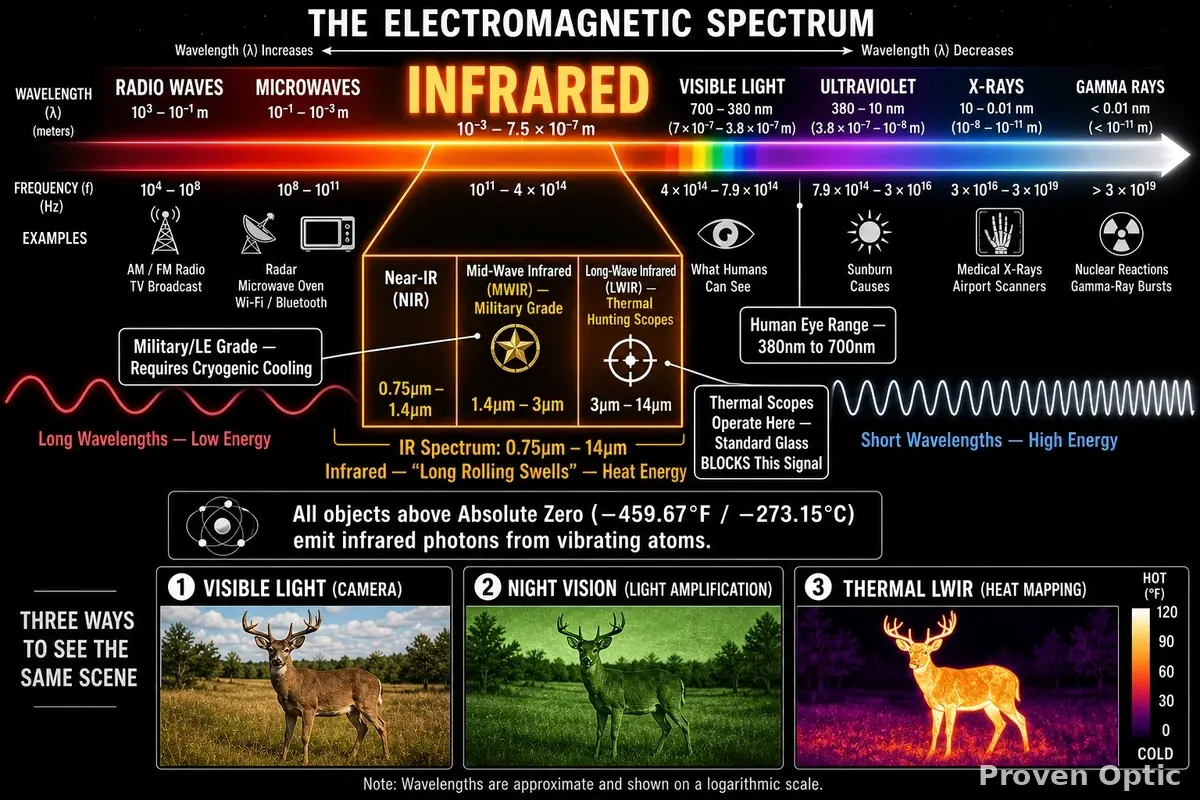
First things first, this article focuses on the electromagnetic spectrum (often abbreviated as the EM Spectrum). We are exploring one portion of the full light spectrum, called the infrared (IR) spectrum. The foundation of any thermal scope is its response to the infrared spectrum.
It’s “Invisible Light”
Infrared sits just beyond the red light your eyes can see—hence the name “infrared,” meaning “below red” on the light spectrum. Even though it’s invisible, infrared travels at the same speed as visible light.
The Difference Is in the Wavelength
Think of visible light as short, choppy waves on water, while infrared light moves in long, rolling swells. Your eyes only pick up the choppy waves, which is why infrared remains unseen.
Why This Matters for Thermal Scopes
Since infrared is a form of light, it can be bent, focused, and magnified by lenses just like visible light. But these longer infrared waves can’t pass through regular glass lenses. That’s why thermal scopes use specialized, often pricey lenses, allowing this invisible light to reach the sensor and form the image you see.
The IR spectrum is emitted by objects with temperatures above absolute zero (-459.67°F or -273.15°C) that consist of vibrating atoms. This vibration releases energy as invisible infrared photons. That vibration creates heat, which is the source, and infrared light is the delivery vehicle that your lens and thermal sensor expose.
Note this scientific fact: Thermal scopes do not see heat; they detect infrared light produced by heat. While you will often hear reviewers say that thermals "react to heat," that is technically incorrect. These devices only see the invisible infrared spectrum of light emitted by warm objects—a distinction that is foundational to truly understanding thermal imaging.
Standard glass is a brick wall to this invisible light signal. Thermal scopes use special lenses made from exotic materials that let long-wave infrared (LWIR) pass through, allowing you to “see” infrared rather than reflected visible light. There’s also mid-wave infrared (MWIR), a higher-performance band mostly reserved for military-grade scopes. Unlike traditional optics that rely on visible light, modern thermal imaging technology can operate in complete darkness, fog, or brush because it detects invisible infrared light emitted by heat rather than ambient light. That also makes it different from night vision, which amplifies available light rather than maps IR light based on heat.
|
Infrared Band |
Use Case |
Characteristics |
|---|---|---|
|
LWIR |
Hunting, civilian |
Best for detecting body IR light; works well in all weather conditions |
|
MWIR |
Military, law enforcement |
Higher sensitivity; better resolution but more expensive and complex |
Thermal optics can detect animals by showing temperature differences day or night, especially when warm bodies stand out against cooler backgrounds.
Knowing what your scope “sees” helps you appreciate why lens materials and design matter more than just resolution or zoom.
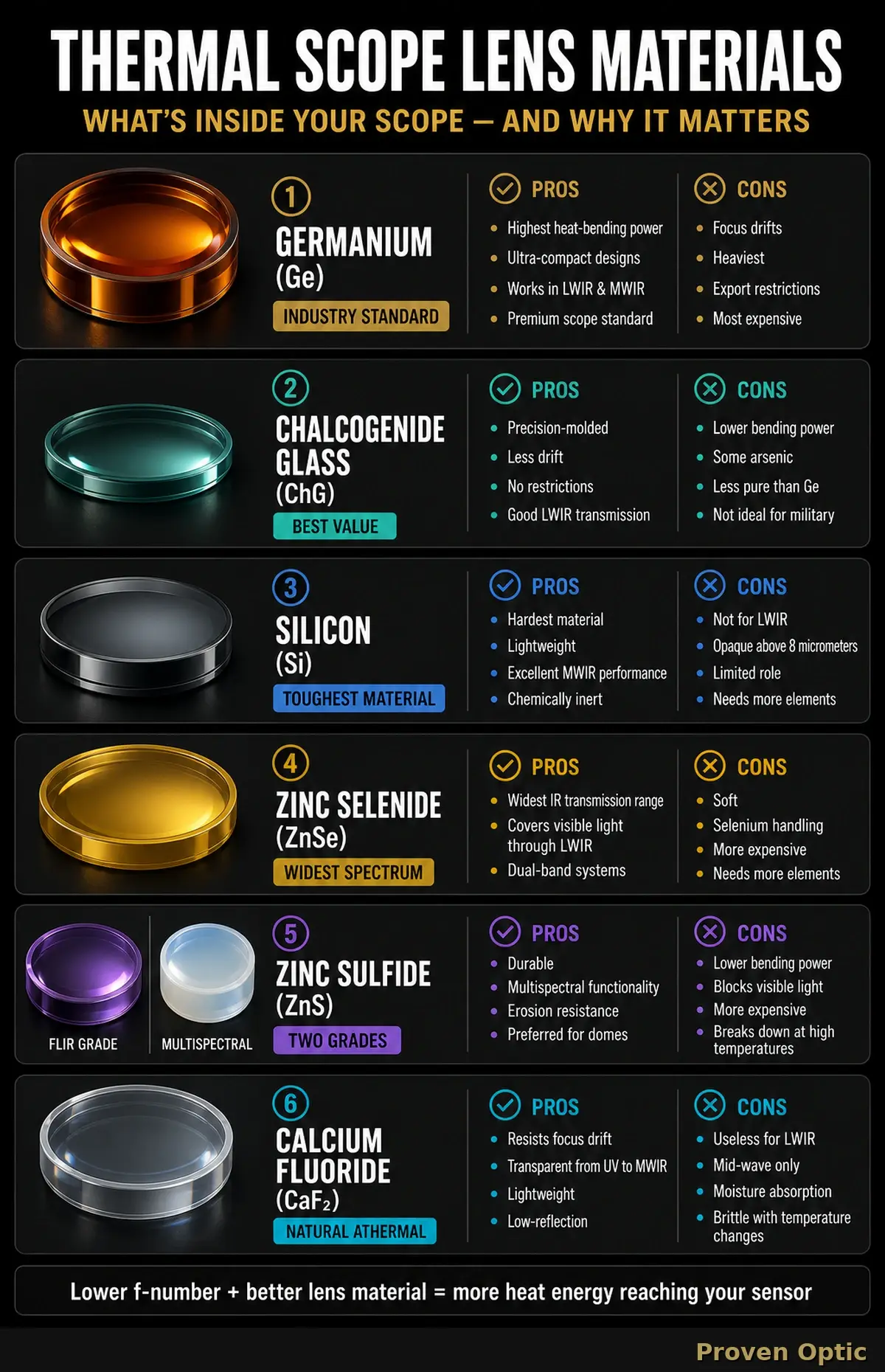
Standard optical glass blocks infrared, so thermal scope lenses differ entirely from traditional glass optics because they must pass long-wave infrared radiation. The lenses in your thermal scope are made from exotic materials that look like they belong in a sci-fi movie prop room. The most common? Germanium, chalcogenide glass, and zinc sulfide/selenide (ZnS/ZnSe), with materials like silicon also used because they’re transparent to long-wave infrared wavelengths.
Germanium is the gold standard—literally. It’s a metal crystal that blocks visible light but is perfectly transparent to thermal radiation. That yellowish-orange tint you see on your scope’s front lens? That’s germanium doing its job.
Chalcogenide glass is a lower-cost alternative. Its moldability into complex shapes makes it common in budget thermal devices, though it doesn’t match germanium’s clarity and durability.
ZnS and ZnSe are used in multi-spectral lenses that pass both visible and infrared light, useful for scopes designed for multiple imaging modes.
The choice of lens material directly impacts image clarity, durability, and your scope's ability to detect infrared light in the field.
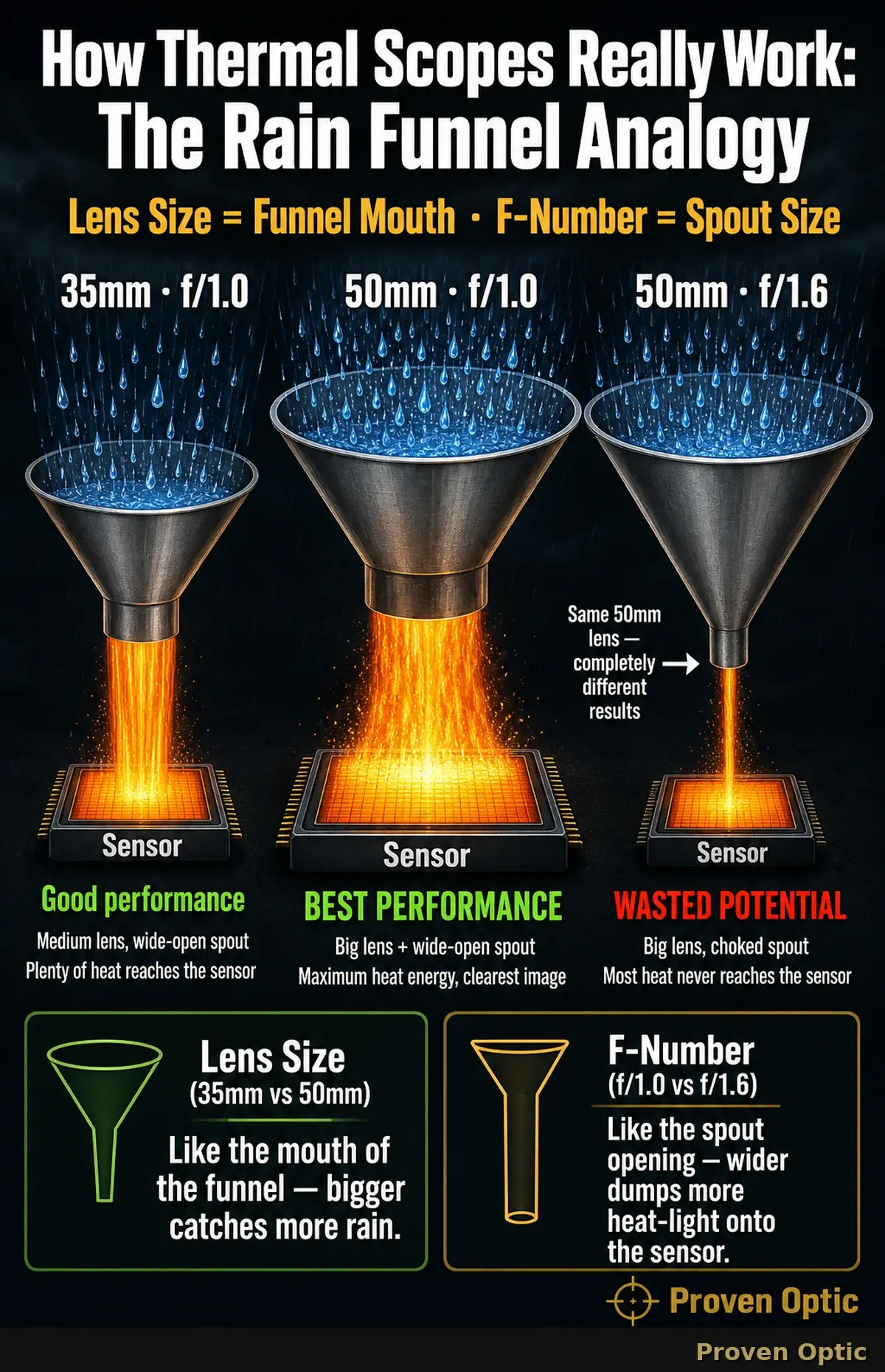
Think of a thermal scope like a funnel catching rain.
The Lens Size (35mm or 50mm): This is the physical width of the top of your funnel. A bigger funnel (50mm) spans a wider area and catches more rain.
The F-Number (f/1.0 vs f/1.2): This is the width of the spout at the bottom of the funnel.
A scope with an f/1.0 rating has a massive, wide-open spout. It instantly dumps all the collected 'light - rain' onto the thermal sensor, giving you a crystal-clear, high-contrast image even in thick fog or rain.
If a scope has a higher number like f/1.2 or f/1.6, the spout (aperture) gets choked down. Even if it has a large 50mm front lens, the choked spout (aperture) restricts the light from reaching the sensor, making the image look grainy and washed out when the weather turns bad.
|
F-Number |
Relative Sensitivity |
Best For |
|---|---|---|
|
f/1.0 |
100% |
Low light, fog, long range |
|
f/1.4 |
50% |
General hunting |
|
f/2.0 |
25% |
Bright conditions, budget |
When shopping, prioritize scopes with the lowest f-number you can find to maximize image clarity and detection range.
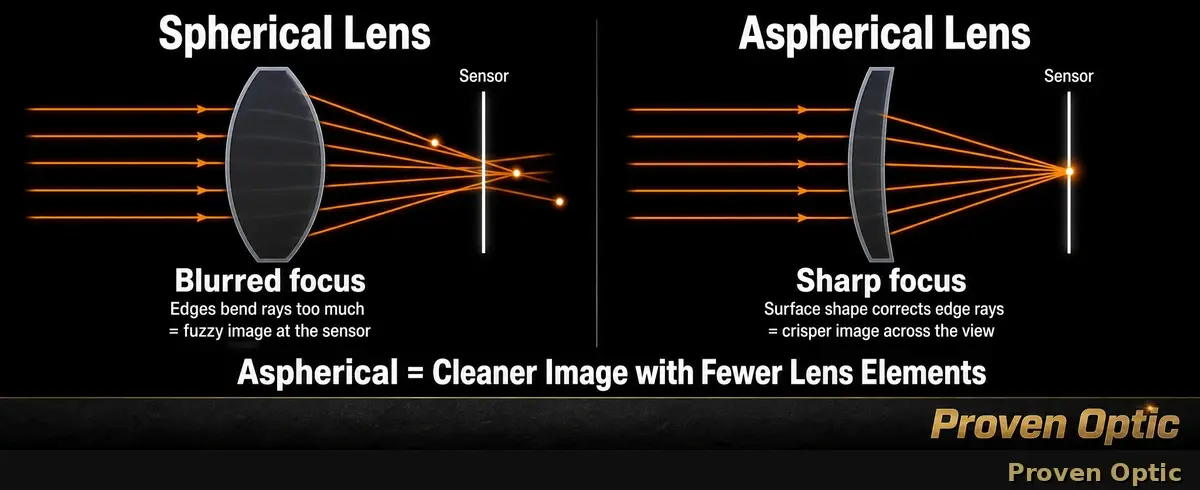
You never thought about this, did you? The shape of your lens surface drastically affects image quality.
A perfectly spherical lens is like a fun-house mirror—it bends light rays at slightly different angles depending on where they hit, causing distortion. Aspherical lenses are precisely shaped to eliminate that distortion, delivering sharper, clearer images.
Diamond-turning machines craft these lenses to tolerances finer than a human hair divided 80,000 times, ensuring your thermal image is crisp and accurate.
Aspherical lenses reduce distortion and improve image clarity, letting you see more detail and make better shots.
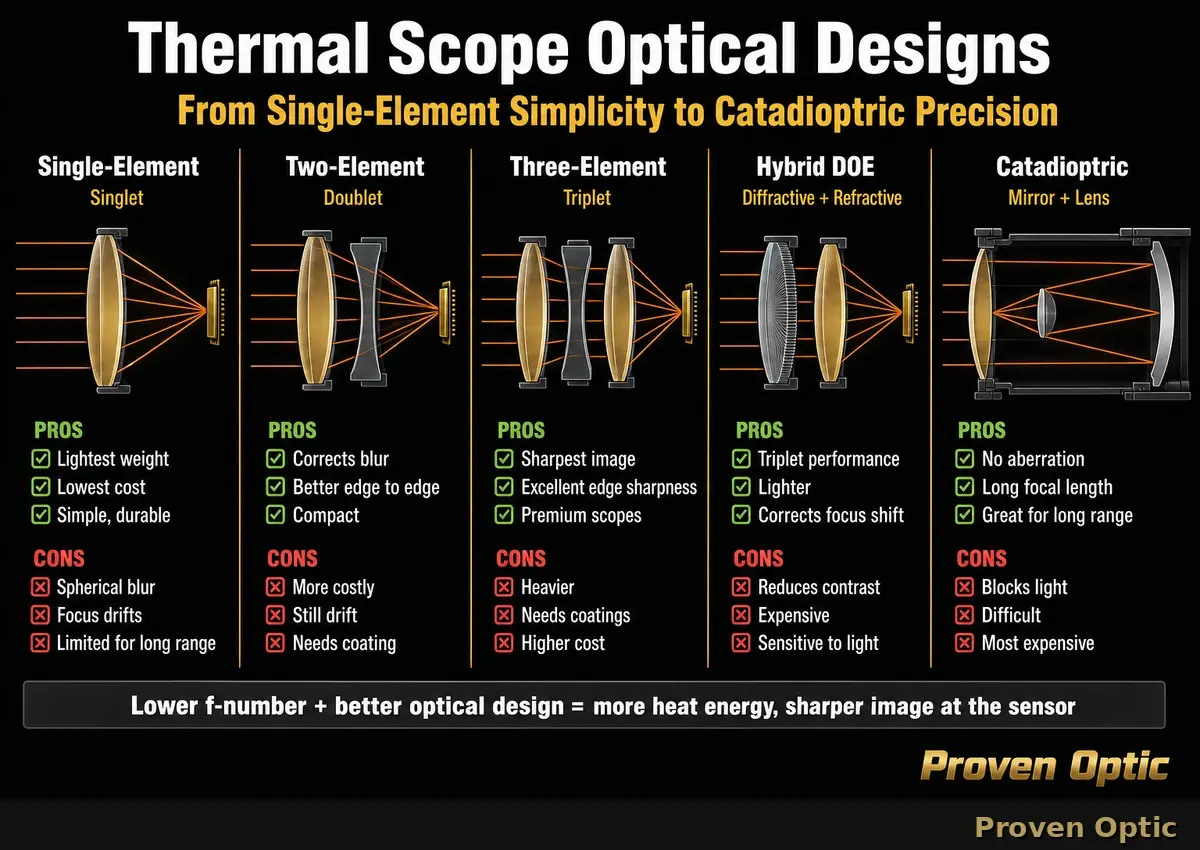
After IR light passes through the objective lens, refraction (bending) is often not fully finished. Thermal sensitivity is greatest when all entering IR light hits the sensor. Therefore, additional refraction systems are needed to ensure every bit of IR light reaches the sensor. There are five individual elements that help thermal scopes work at the high levels.
Single-Element (Singlet) Designs
A single lens element, almost always aspherical germanium or chalcogenide. Common in compact, low-cost LWIR cameras with small sensors (160×120 or 320×240). Simple, lightweight, low-cost — but spherical aberration, chromatic aberration, and thermal defocus are difficult to fully correct in a single element. Most factory-focus or fixed-focus thermal scopes use this approach
Two-Element (Doublet) Designs
A two‑element (doublet) thermal lens uses a strong front germanium lens plus a correcting second lens (ZnS or chalcogenide) to sharpen the image and reduce temperature‑induced focus shift in most 35–50 mm hunting scopes.
Three-Element (Triplet) Designs
A three‑element (triplet) thermal lens uses three carefully chosen elements to correct almost all image defects (blur, coma, color shift, and thermal focus drift), so high‑end 50–75 mm hunting and military scopes often use triplets for the sharpest, most stable images, at the cost of higher price, weight, and some extra light loss.
Hybrid refractive–diffractive (DOE) designs
Add a thin diffractive surface to the lens stack so that one element behaves like a “smart corrector,” allowing a two‑element system to match triplet‑level sharpness while passively correcting both color- and temperature‑induced focus shifts, at the cost of greater manufacturing difficulty and increased sensitivity to wavelength and stray light.
Catadioptric (mirror + lens) designs
Use curved mirrors with a small corrector lens (Cassegrain‑style) so infrared is folded back and focused without any chromatic aberration, enabling very long‑range, compact thermal optics with broad IR band coverage, but with central obstruction, tougher alignment, and impracticality for short rifle‑scope focal lengths.
These refraction element systems clearly allow more thermal energy (IR light) to the sensor when designed correctly. An added bonus is that digital zoom may be more usable with less blur.
If you're finding yourself in the deep end of the pool before the shallow end and need a broader view (no pun intended) about the lens and learning the other parts, check out the full thermal scope overview guide.
You’ve zeroed your scope at the truck in the afternoon heat. By 3 AM in the stand, the image is soft. You blame the scope, but the real culprit is your lens.
Thermal lenses expand and contract with temperature changes—a property called dn/dT—shifting the focal point just like a guitar string going out of tune. This causes your image to blur or lose focus.
Athermalization is the solution. Passive athermalization is like “set-it-and-forget-it,” using materials and design to cancel out temperature effects. Active athermalization is “auto-tune,” mechanically adjusting focus as temperature changes. Many modern thermal scopes are also rated for extreme temperatures—sometimes down to -4°F (-20°C)—and outdoor abuse, so check waterproof ratings and drop-test ratings before you buy. For the highest quality durability testing in harsh conditions, look for MIL-STD-810, which covers operating temperatures, humidity, vibration, and drop resistance.
Field Test: An uncompensated germanium lens in a 104°F (40°C) temperature swing can shift focus by the equivalent of adjusting your diopter 13 full clicks. Your image isn’t blurry—it’s physically out of focus.
Athermalized lenses keep your image sharp through temperature fluctuations, which is critical for reliable performance.
Lens coatings are a key component that is often overlooked but can have major drawbacks if not investigated in a purchase. There are two purposes for lens coatings.
Protection from the abuse a lens can take in the field.
The correct coatings act as an Anti-Reflective sponge, vastly improving the amount of IR light entering the scope's sensor.
Although germanium has great refraction capabilities (bending of IR light), uncoated germanium reflects 36% of IR light at every surface. A two-element scope without coatings throws away 83% of the IR signal before it reaches your sensor.
Anti-reflective (AR) coatings are the single biggest “free upgrade” a manufacturer can give a scope. They drastically reduce reflection losses, boosting image brightness and contrast. There are four reflected-light coatings, each with its own pros and cons.
Single-Layer Anti-Reflection (AR) Coatings
Pros - Simple deposition; robust; adequate for narrowband applications.
Cons - Only effective over a narrow wavelength range (~10–15% bandwidth); reflectance outside the design band can be higher than uncoated
Multi-Layer Broadband AR (BBAR) Coatings
Pros - Maximum transmission improvement; works across the full operational band.
Cons - Multi-layer stacks are more mechanically fragile than single-layer coatings; risk of delamination in extreme humidity or under abrasion.
Diamond-Like Carbon (DLC) Coatings
Pros - Combines AR function with exceptional physical protection; meets or exceeds stringent military environmental standards; chemically inert and nonporous; fracture-resistant film structure.
Cons - Single-layer DLC is optimal only over a narrow spectral band unless combined with additional multi-layer AR; the deposition process is more specialized than standard evaporative coatings.
Hard Carbon (HC) / Yttrium Fluoride (YF₃) / Other Hard AR Coatings
Pros - Better spectral coverage than single-layer DLC; tailored to specific environmental requirements.
Cons - None individually match DLC's hardness or MIL-spec abrasion performance.
When buying, look for scopes with multi-layer AR or DLC coatings to get the highest image clarity and durability.
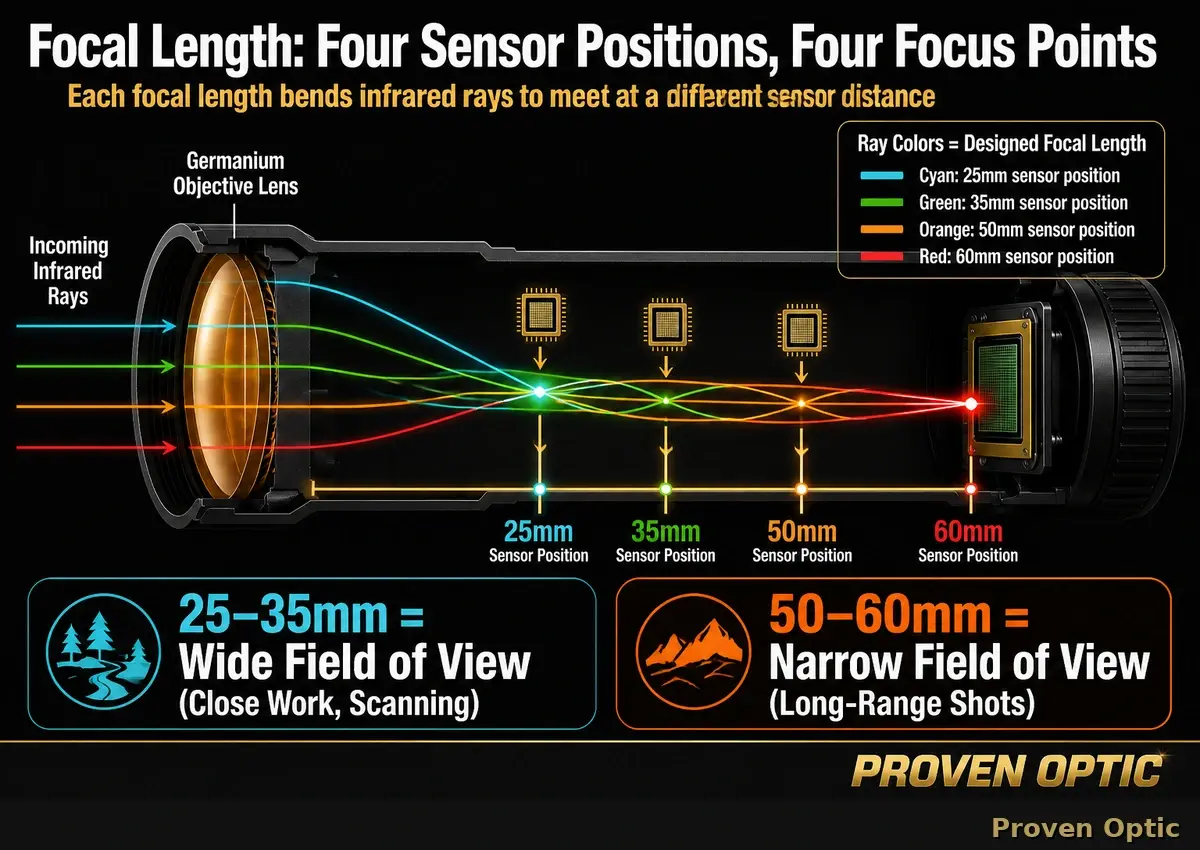
Every millimeter of focal length you add, along with increasing lens size, buys you magnification and detection range—but costs you field of view and ease of close-range scanning.
|
Focal Length (mm) |
Typical Magnification |
Field of View |
Best Use Case |
Detection Range |
|---|---|---|---|---|
|
25 |
Low |
Wide |
Close-range, dense cover |
Short |
|
35 |
Moderate |
Balanced |
General hunting |
Medium |
|
50 |
Higher |
Narrower |
Mid-range shots |
Longer |
|
75 |
Highest |
Narrowest |
Long-range precision |
Longest |
Your base magnification matters just as much: higher magnification makes targets look closer, but it also narrows field of view and can make scanning less practical. A larger lens is generally the better fit for long-range use, but optical zoom is only as useful as the sensor resolution behind it.
For example, a 640x480 thermal will usually hold more detail than a 384x288 unit at distance, supporting better identification range with less pixelation. That’s because sensor size and resolution drive image detail, and high resolution helps reveal finer differences between animals or objects farther out. Good display quality and a capable display screen also matter, since they help preserve clarity as you zoom. Thermal lenses also have a tighter depth of field than daytime optics, so manual focus is often needed for a sharp image.
Choose your focal length based on your typical hunting distances and terrain to balance magnification and situational awareness, and remember that detection at extreme distances is possible, but reliable identification always comes much closer.
Here’s a pub trivia fact: your scope can actually see itself, creating a dark ghost image right in the middle of your reticle. This is called the Narcissus effect—a strange quirk of thermal optics, but usually only needs to be engineered to overcome in the MWRI range.
Looking ahead, metalenses are revolutionizing thermal optics. Researchers have built thermal lenses thinner than a human hair, with nanopatterned surfaces that replace bulky germanium elements.
In 10 years, your scope’s entire objective lens might be a flat chip, radically shrinking size and weight while boosting performance.
Understanding these cutting-edge developments shows you how thermal scope technology is evolving—your next scope might be lighter, smaller, and more powerful than you ever imagined.
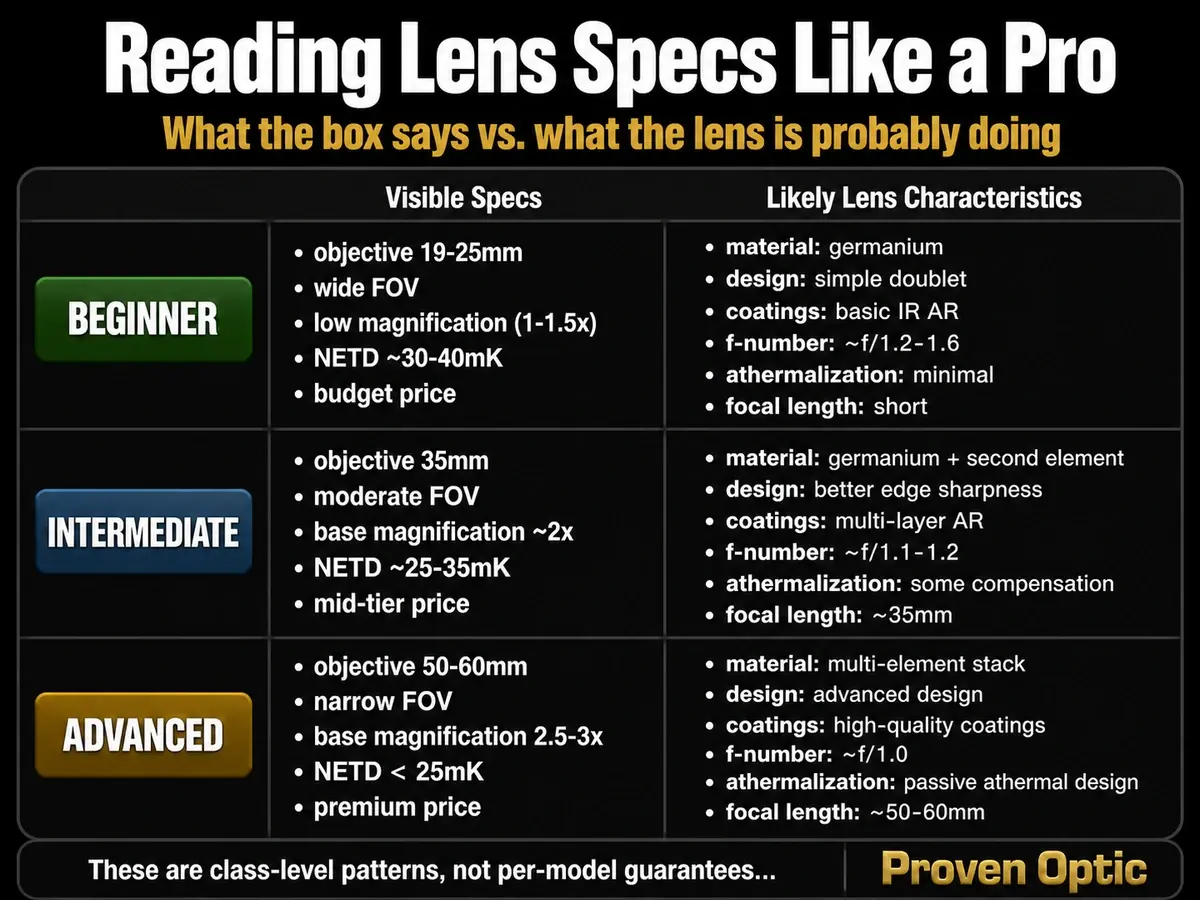
Most thermal scope spec sheets tell you very little about the lens itself. You’ll see objective size, sensor resolution, maybe NETD and detection range, but usually not the f-number, lens material, or how many elements are inside.
You can’t force manufacturers to reveal that, but you can read between the lines.
By combining a few visible specs, you can make educated inferences about whether a scope is running a simple lens, a more advanced doublet, or a premium triplet, and whether the lens is likely the weak link or a real strength.
If at all possible, try to get the below list checked off to buy with confidence.
What is the f-number? (Aim for f/1.0–f/1.2)
What lens material is used? (Germanium = premium; chalcogenide = cost-efficient)
Is the lens athermalized? (Passive = most reliable)
Does it have DLC or multi-layer AR coatings? (Military-grade = MIL-C-48497)
What focal length matches my hunting distances? Longer focal lengths generally suit thermal hunting in open terrain, while shorter focal lengths are better for scanning tighter cover.
Is it LWIR or MWIR? (LWIR for hunting, MWIR for military/LE)
What sensor performance should I ask about? For most thermal scopes, focus on sensor resolution, NETD, the smallest temperature difference the unit can resolve, and the quality of its image processor rather than vague claims about clarity.
How good is the display and output? A sharp OLED display helps present the processed image clearly, and better image processing turns detected infrared energy into a usable heat map with stronger target separation.
What will I actually use it for? Thermal optics are widely used because living things stand out against cooler backgrounds; they can cut through mist and fog better than visible-light systems, and they work well for hunting, surveillance, search and rescue, and wildlife observation without disturbing animals (especially for night hunting, predator control, and to hunt hogs).
How long will it run in the field? Check battery life, whether it has internal memory for saved media, and whether it can run from a power bank during longer outings.
What additional features are included? Ask about recording options, palette modes like white hot, and other extras that improve the experience with a thermal rifle scope.
As these questions suggest, the lens is very important, but there are other parts to consider. Read this article to further learn how all thermal scope parts work together.
One of the key differences versus night vision is that thermal is usually better for finding hidden animals, while night vision is often better for fine visual detail, which helps buyers judge whether thermal scopes are worth the investment for their use.
Asking these questions ensures you get a thermal scope lens that delivers real-world performance, not just marketing hype.

Thermal scope lenses work by capturing invisible infrared light emitted by all objects—and focusing it onto a thermal sensor to create a visible map. Unlike traditional scopes that rely on glass lenses to transmit visible light, thermal lenses use specialized materials such as germanium, chalcogenide glass, or zinc sulfide/selenide because these materials transmit long-wave infrared (LWIR). This key difference enables thermal scopes to function perfectly in complete darkness, fog, or bright sunlight by detecting infrared light produced by heat rather than reflected light.
The most important features to consider in a thermal scope lens include the material, with germanium being the premium choice for clarity and durability; the f-number (aperture), which controls how much light energy reaches the sensor—lower f-numbers (around f/1.0) mean brighter, higher-contrast images, especially in challenging conditions; and lens coatings like multi-layer anti-reflective or diamond-like carbon coatings that maximize the IR spectrum transmission and protect the lens from damage.
Additionally, focal length and objective lens size affect magnification, field of view, and detection range. Larger lenses and longer focal lengths provide greater magnification and longer detection distances but narrow the field of view, so your choice should match your typical hunting or tactical environment. Finally, advanced lens shapes, such as aspherical designs, reduce distortion, and athermalization helps maintain sharp focus despite temperature changes in the field.
Understanding these factors lets you see beyond the basic specs and choose a thermal scope lens that delivers superior clarity, reliability, and real-world performance for your needs. To put this thermal lens learning objective into its full understanding, pair this with our ultimate complete guide to thermal scopes.