

CALL US TODAY
1-(844)-809-9990

Skip To:
If you have ever watched a hog appear as a bright shape in an otherwise dark field, you have seen why serious hunters and tactical users trust thermal optics. Our collection of thermal scopes and supporting articles helps you select the perfect setup. This guide explains how thermal scopes work, what the core specs mean, and how that knowledge helps you choose a thermal scope that fits your terrain, distances, and mission.
Thermal scopes detect infrared radiation emitted by objects and convert that heat energy into a visible image. Instead of depending on visible light, the scope reads temperature differences in the scene and turns them into a heat map your human eye can understand.
The basic chain is simple: the objective lens gathers infrared light and focuses it onto a thermal sensor; the microbolometer measures subtle temperature differences; the image processor cleans, sharpens, and enhances the signal; and the display shows a thermal image in which warmer objects stand out by thermal contrast.
Picture a hog at 150 yards on a cool November night in Texas. The ground may be 45°F, while the hog’s body heat is close to 100°F. A quality thermal scope makes that animal pop against the cooler soil and grass. Because thermal imaging technology operates independently of visible light, it works in daylight, low light, and even in complete darkness, where traditional scopes and many night vision devices struggle.
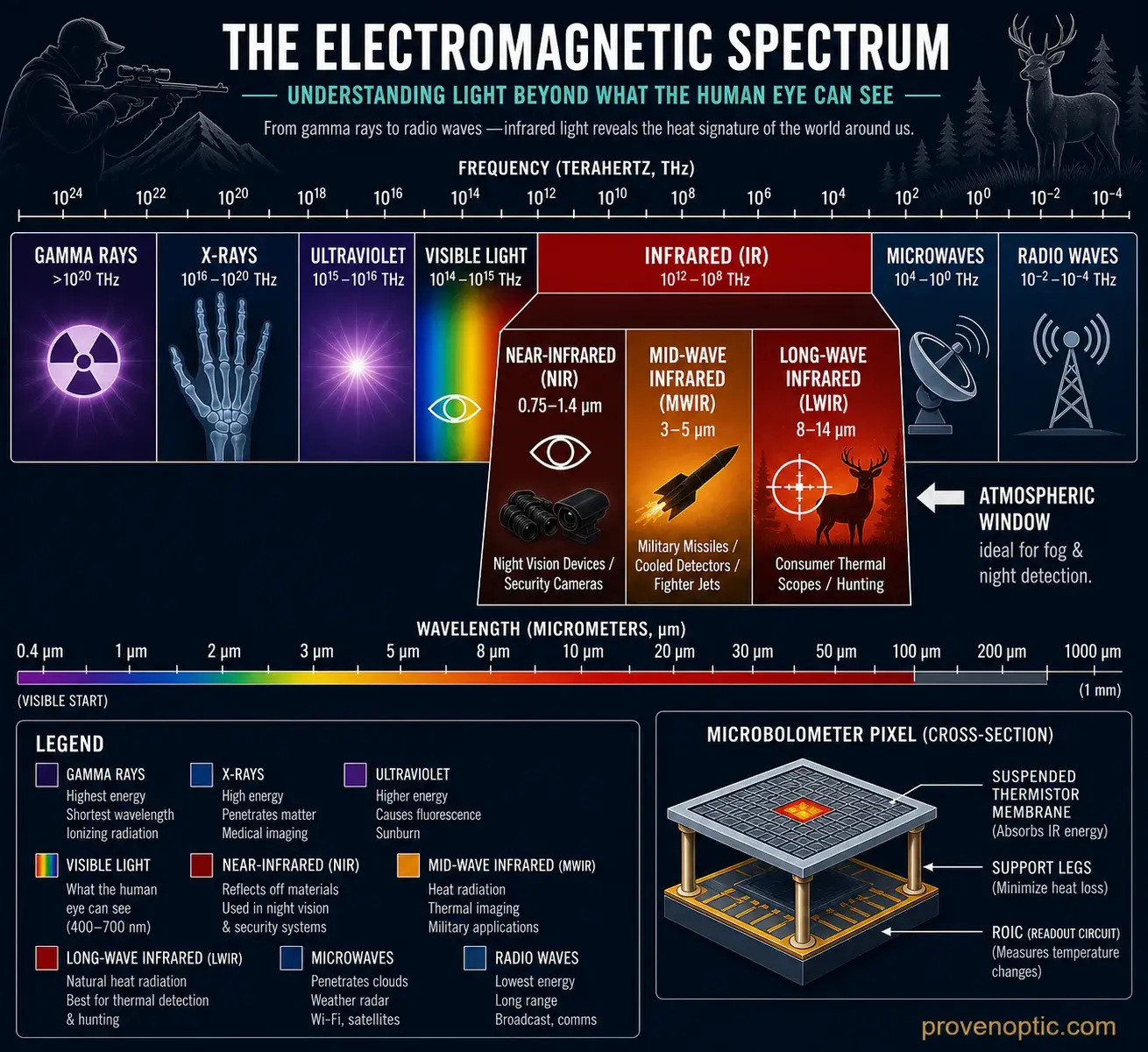
Infrared radiation is energy just beyond red light in the electromagnetic spectrum. These infrared waves are invisible to the naked eye, but thermal imaging sensors can detect them.
Anything above absolute zero, or −459.67°F / −273.15°C, produces infrared emission. The hotter an object is, the more infrared energy it gives off. Thermal scopes generally use long-wave infrared, often in the 8–14 μm band, which is ideal for detecting animals, people, and other warmer objects.
Thermal devices are passive. They do not project beams or “light up” a field. They receive invisible infrared radiation and measure the heat energy emitted by the environment. Unlike night vision, which relies on reflected light, ambient light amplification, or an IR illuminator, thermal vision detects thermal emission directly.
Most modern thermal scopes share the same internal architecture, even though performance varies widely between models. The big pieces are the objective lens, thermal sensor, readout integrated circuit (ROIC), image processor, display, and battery system. For a high-level overview, see our ultimate guide to thermal optics.
These parts must work together. Image quality, detection range, durability, and battery life are never determined by a single spec. At Proven Optics, we focus on balanced thermal optics for real hunting and tactical use, not just impressive numbers on a spec sheet.
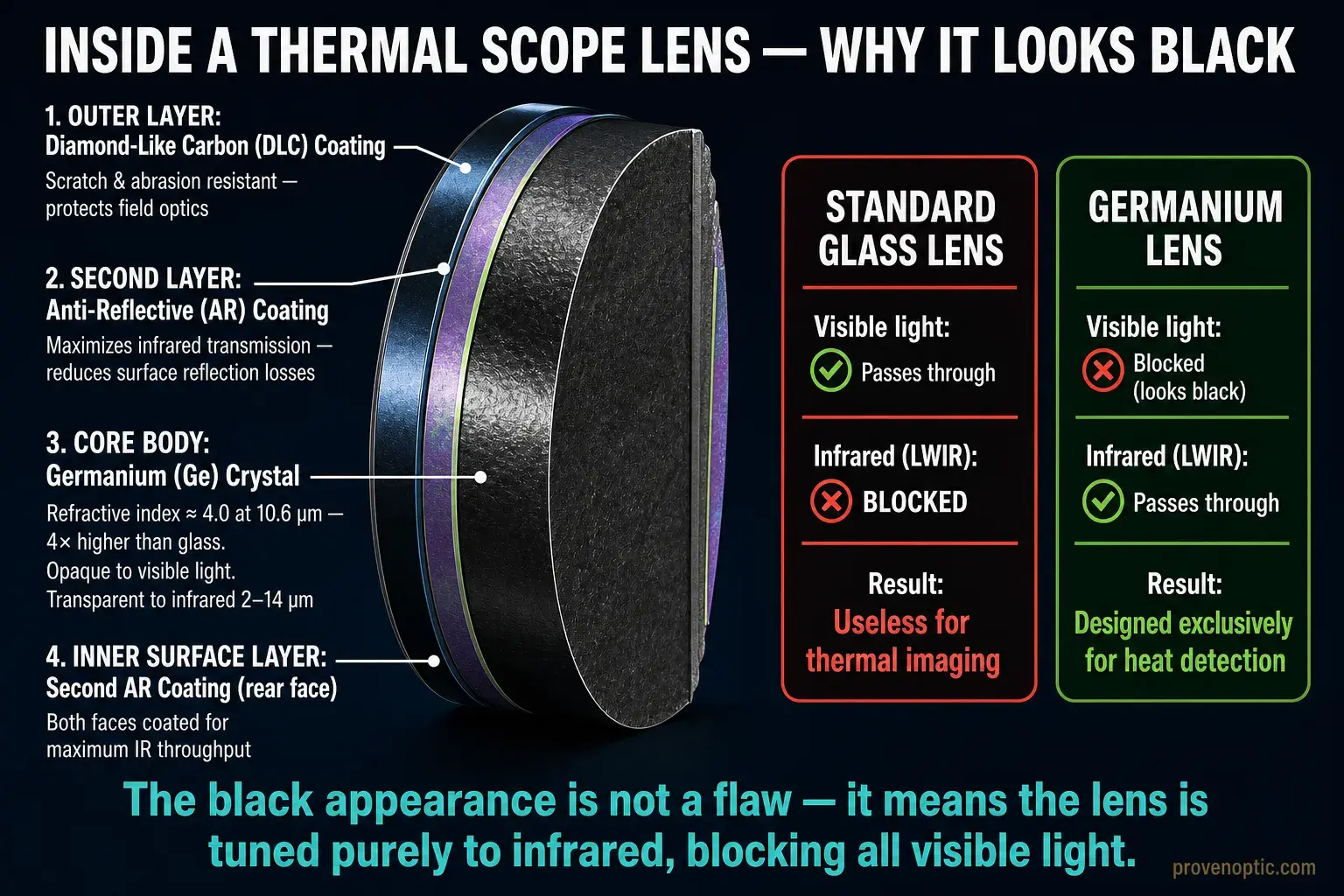
The objective lens gathers infrared radiation from the field of view and focuses it onto the thermal sensor. It works like a camera lens for heat, but standard glass blocks long-wave infrared energy.
Thermal lenses are made of a specialized material called germanium that allows infrared light to pass through. Some designs also use zinc selenide or specialty infrared glass. Lens coatings matter because drizzle, dust, coastal humidity, and other environmental factors can reduce image clarity. For a deep dive into the importance of lens design and setup, check out the article that explains thermal scope lenses.
Lens size changes how the scope behaves:
|
Lens Size |
Best Use |
Field Behavior |
|---|---|---|
|
25mm |
Timber, scanning, short-range detection |
Wider FOV, faster target pickup |
|
35mm |
General hunting |
Balanced magnification and scanning |
|
50mm–60mm |
Open fields, long-range detection |
More reach, narrower field of view |
|
The field of view (FOV) of a thermal scope is determined by the lens size and magnification, affecting how much area can be scanned at once; a wider FOV is beneficial for tracking movement, while a narrower FOV is better for long-range targeting. |
||
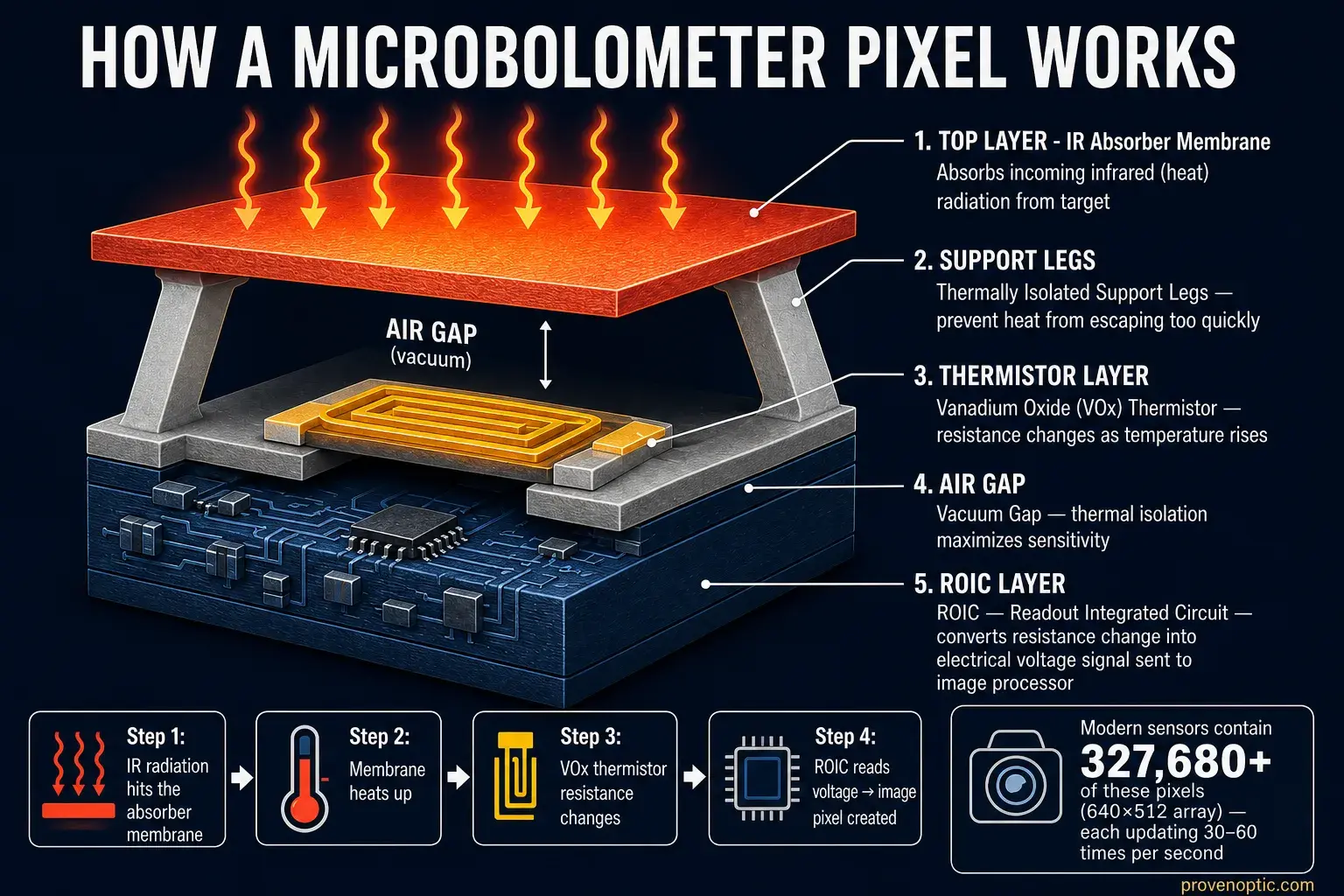
The core component of thermal scopes is the microbolometer, which converts infrared energy into electrical signals, allowing for the creation of detailed thermal images. Each pixel responds to incoming heat by changing its electrical resistance, which generates an electrical signal.
Directly beneath the microbolometer sits the Readout Integrated Circuit (ROIC). The ROIC plays a critical role by capturing the electrical signals from each pixel and converting them into a format suitable for further processing. It acts as the interface between the sensor and the image processor, ensuring accurate and efficient signal transfer.
Most hunting thermal imaging devices use uncooled VOx or amorphous silicon microbolometers. “Uncooled” means they operate near room temperature without cryogenic cooling, unlike older cooled detectors used in military operations and specialized systems. This makes modern devices more compact, rugged, quiet, and practical for field use.
Sensor resolution refers to the number of pixels in the microbolometer sensor and affects the quality of the imagery produced. Common resolutions include 256x196 for short-range detection, 384x288 for general use, and 640x480 or higher for long-range identification. You will also see 256×192, 640×512, and 1280×1024 in current or emerging thermal scopes.
Pixel pitch refers to the spacing between pixels within the microbolometer, typically 12 μm or 17 μm. A smaller pitch can improve pixel density and detail, but the lens and processing must support it.
NETD is a performance characteristic of the microbolometer. Thermal sensitivity, measured as Noise Equivalent Temperature Difference (NETD), indicates how small a temperature difference a thermal sensor can detect; lower mK values signify greater sensitivity and better performance in challenging conditions. In plain English, the noise-equivalent temperature difference tells you how well the sensor can distinguish faint heat variations from electronic noise.
A NETD value below 25 mK is considered high sensitivity, enabling thermal devices to detect subtle temperature differences, which is crucial in low-contrast conditions such as fog or rain. Thermal imaging devices with a NETD rating of 15 mK or lower can reveal fine details, such as the outline of an animal or residual heat traces, enhancing target recognition capabilities.
The image processor is the brain of the scope. It takes raw microbolometer sensor data, which the Readout Integrated Circuit (ROIC) first captures and converts from electrical signals into a format suitable for processing, and turns it into real-time thermal imaging work you can actually use.
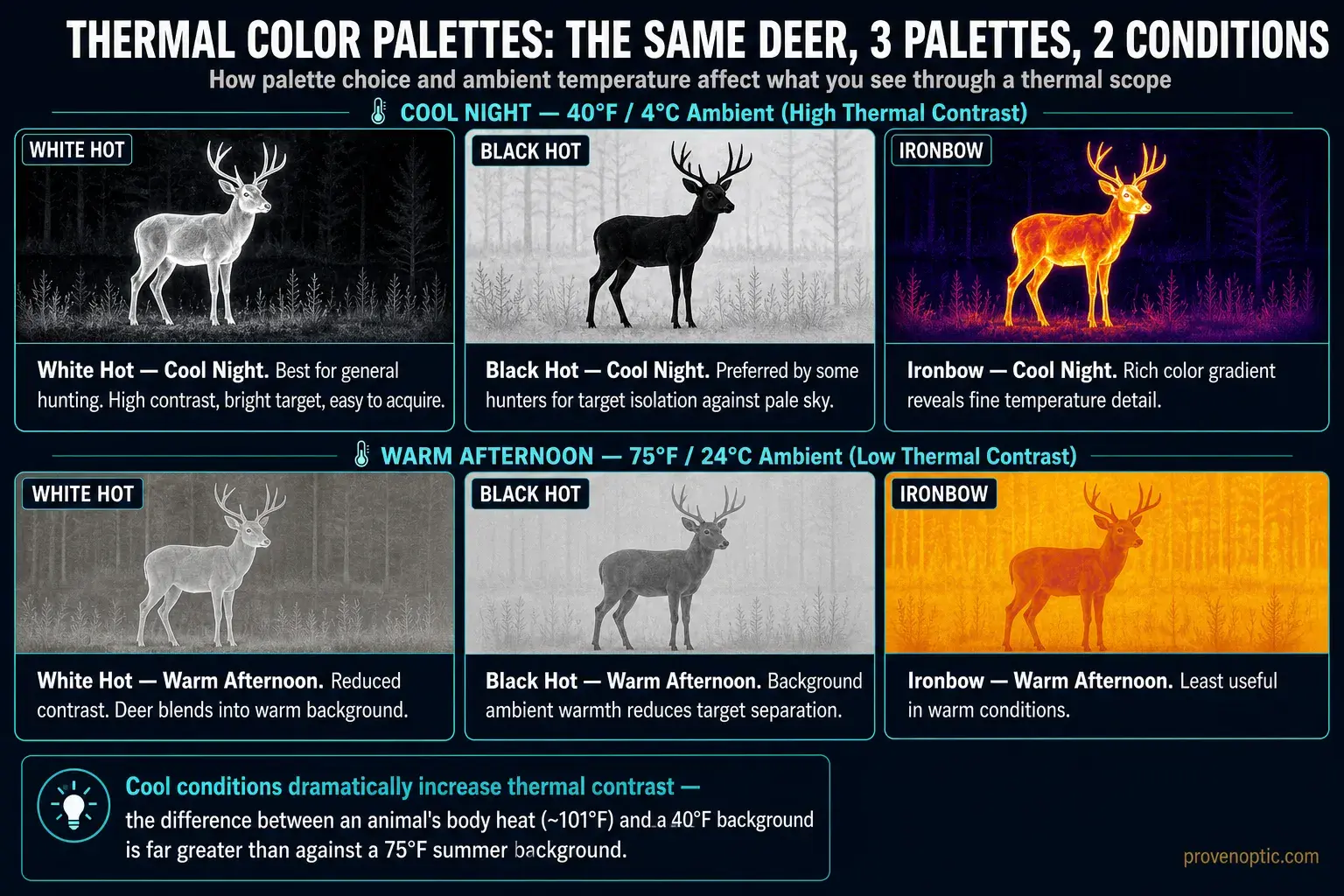
The signal processing unit applies calibration, noise reduction, sharpening, and contrast-enhancing algorithms. It also maps heat variations into palettes such as white hot, black hot, red hot, and other color modes. Thermal images display warmer objects as bright while cooler objects appear dark, depending on the chosen color palette.
A good processor can make a mid-tier sensor look noticeably better in practical conditions. Frame rate, measured in Hertz, determines how many frames per second the screen displays, which affects viewing fluidity. A 25 Hz image may work for slow scanning, while 50–60 Hz is better for tracking running hogs or coyotes.
Modern thermal scopes usually use OLED or AMOLED microdisplays. Display resolution, brightness, contrast, and refresh all affect perceived image quality, especially when you are glassing for faint heat signatures in humid air.
Battery life is an important consideration when choosing a thermal scope, with many models offering 6 to 12 hours of continuous operation and some allowing external power sources to extend battery life. Cold weather, high brightness, recording, Wi-Fi, and digital zoom can shorten runtime.
Durability and weather resistance are key features to look for in thermal scopes, with specifications such as IP ratings indicating how well the device can withstand dust and water exposure. For hard-use hunters and tactical teams, field-swappable batteries and clear battery indicators are more than conveniences.
Thermal scope datasheets often list multiple specifications that sound similar but refer to different components, which can confuse even experienced users. To help you make informed decisions, it’s important to distinguish between sensor specs and display specs, and to understand how the processor affects the final image quality.
Sensor Resolution refers to the number of pixels in the microbolometer sensor itself, such as 384×288 or 640×512. This determines the raw thermal data the scope can detect and directly impacts image clarity and detail at the source.
Display Resolution is the number of pixels on the scope’s screen (OLED or AMOLED). A higher display resolution provides a sharper image to your eye, but it cannot add detail beyond what the sensor captures. The raw sensor data is captured only by the sensor.
Sensor Pixel Pitch is the physical distance between individual pixels on the thermal sensor, usually measured in micrometers (µm). A smaller pitch means more pixels can fit in the same sensor size, improving image detail and thermal discrimination.
Display Pixel Pitch refers to the spacing between pixels on the screen and affects how smooth and clear the image appears, but it does not influence the thermal data captured.
Understanding the distinction between sensor specs and display specs helps you evaluate thermal scopes more accurately. A high-sensor-resolution scope with a decent display will usually outperform a scope with a high display resolution but lower sensor quality.
Similarly, a low-pixel-pitch sensor combined with advanced processing offers better detection of subtle temperature differences, which is crucial for hunting in challenging environments such as fog or dense cover.
By clarifying these specs, you can better align your purchase with your specific needs—whether it’s long-range detection, close-range identification, or smooth image tracking.
Here is what happens the moment you shoulder the rifle and scan a Kansas wheat field for coyotes:
The objective lens gathers invisible infrared energy from everything in the field of view and focuses it onto the microbolometer.
Each pixel changes electrical resistance based on the infrared energy it receives, creating a raw heat map signal.
The image processor converts that signal into digital data, then applies calibration, noise reduction, and thermal contrast enhancement.
The processor assigns temperatures to your selected palette that will and sends the final thermal video to the display at the chosen refresh rate.
If a coyote holds still near a terrace or slips through light vegetation, the visible image through conventional glass may show nothing. A thermal scope can still detect heat because the animal’s body radiates more thermal energy than the background. While detection range depends on sensor resolution, lens size, NETD, humidity, target size, and image interpretation, you can easily calculate your exact target specs using our thermal scope specification finder.
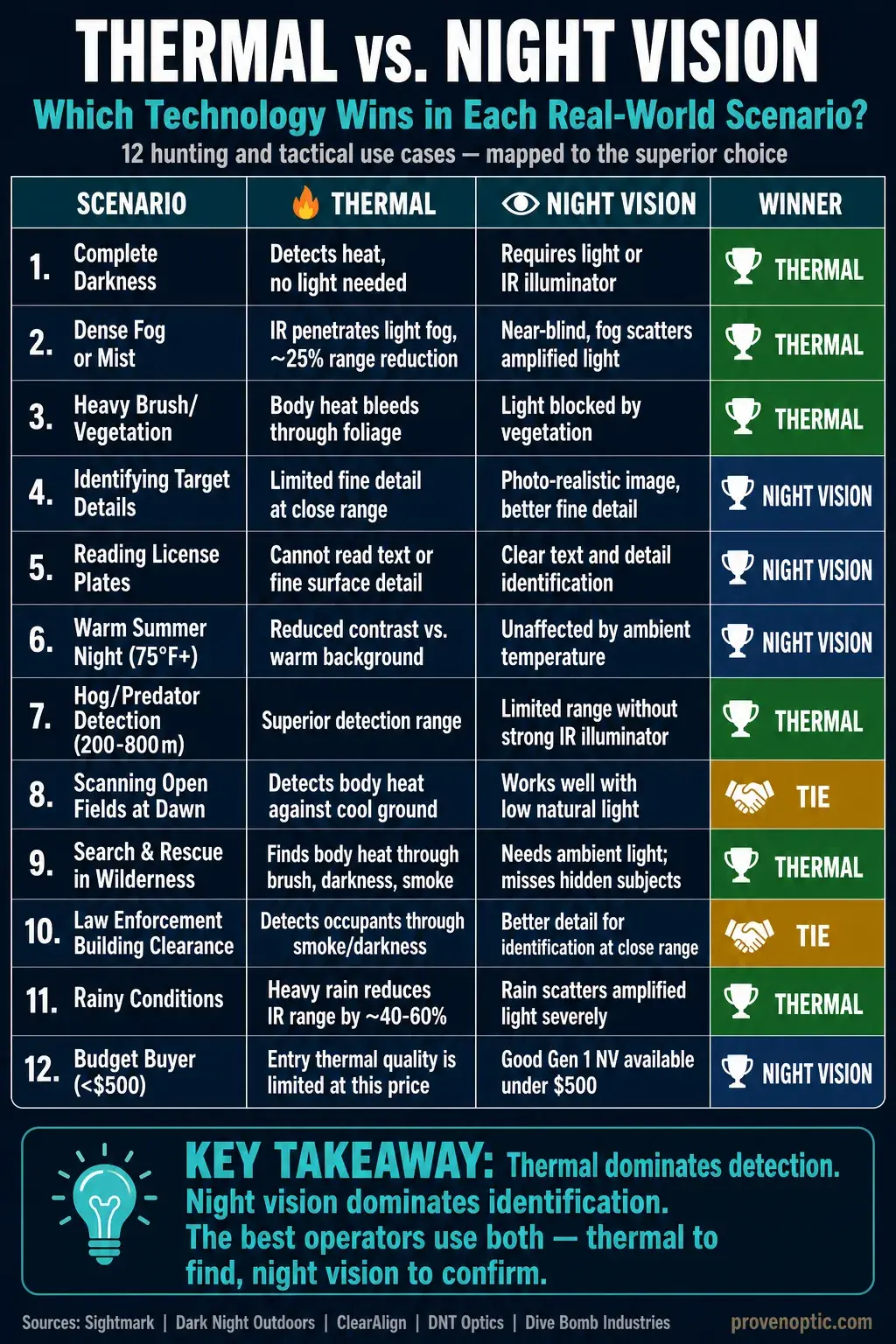
Thermal scopes detect heat signatures through infrared radiation, while night vision devices amplify visible light to create images in low-light conditions. That one difference changes everything in the field.
Thermal imaging can see through fog, smoke, and complete darkness, whereas night vision requires some ambient light to function effectively. Night vision devices provide a more natural image resembling daylight viewing. Still, they struggle in conditions with no light, such as total darkness or heavy fog, whereas thermal scopes excel in these situations.
Night vision is still excellent for navigation, reading terrain, identifying faces at close range, and moving without white light. Many serious hunters and tactical professionals use thermal for finding targets and night vision for movement or fine detail.
The specs that matter most are the ones that change what you see in real conditions, along with understanding what thermal scopes cannot do to set realistic expectations.
Sensor resolution: More pixels improve detail and identification. The resolution of thermal optics is crucial for image clarity, with common resolutions including 256x196 for short-range detection, 384x288 for general use, and 640x480 or higher for long-range identification.
Pixel pitch: A smaller pitch can improve detail and keep the scope size manageable.
Detection range: A mid-range scope may detect a hog at 1,000–1,500 yards in ideal conditions, but positive identification happens much closer.
NETD: Lower mK means stronger sensor sensitivity in low-contrast scenes.
A refresh rate of 50–60 Hz helps with fast movement and smoother panning.
Base magnification and FOV: Wide views help scanning; narrow views help with precise long-range work.
Digital scopes create images from visible light. Thermal imaging scopes create images from heat. That is why thermal technology is so useful when lighting conditions are working against you.
Humidity, fog, rain, and mist can scatter or mask infrared radiation. In low-visibility conditions such as fog, mist, or darkness, thermal imaging excels at detecting heat signatures, allowing hunters to track game effectively after dusk. However, heavy moisture can still soften edges and reduce effective range.
Thermal crossover is another challenge. Just after sunrise or sunset, the ground, trees, rocks, and animals may sit at similar temperatures. With less separation, the scope has less thermal contrast to display.
Low-NETD scopes preserve more detail when conditions get marginal. You can also improve the view by adjusting brightness, contrast, sharpness, and palette. Switching from white hot to black hot can sometimes reveal edges that were blending into the background.
At Proven Optic, we care about how scopes perform in open fields, timber, humid river bottoms, and rough weather, not only how they look in lab-style demonstrations.
While thermal scopes offer remarkable advantages, it’s important to understand their limitations:
Thermal scopes detect infrared radiation emitted by surfaces but cannot see through walls, glass, thick foliage, or other solid barriers. These materials block or absorb heat signatures, preventing detection beyond them. Glass, for example, blocks long-wave infrared radiation, which is why thermal scopes cannot see through windows or similar transparent barriers.
Thermal imaging excels at detecting heat differences but typically lacks the fine detail needed for species identification or reading text and markings. Positive identification often requires closer range or supplemental optics like night vision.
Heavy rain, thick fog, or elevated humidity levels can disperse infrared radiation, leading to decreased image sharpness and a shorter detection range. Thermal crossover periods—when ambient temperatures match animal body heat—also diminish contrast, making targets harder to distinguish.
Thermal scopes consume significant power, especially models with high refresh rates or video recording. Limited battery life can restrict continuous use in the field unless spare batteries or external power sources are available.
Thermal imaging devices tend to be more expensive than traditional optics and may require learning to interpret heat maps effectively. Maintenance and calibration are also necessary to ensure optimal performance over time.
Understanding these limitations helps hunters and tactical users choose the right tool for their mission and avoid surprises in the field.
Understanding thermal imaging helps you hunt smarter and recover game more responsibly.
Thermal scopes allow hunters to detect animals in dense cover by visualizing their body heat, making it easier to spot camouflaged game even in thick vegetation. Heat signatures can appear through gaps in grass, brush, or timber where traditional scopes see only shadow and texture.
Thermal scopes provide a significant advantage in tracking wounded game by detecting residual body heat, enabling faster recovery and reducing animal suffering. In the right conditions, you may also spot blood pools, warm ground contact, or heat trails for several minutes after impact.
For long shots, thermal helps you find animals before you could see them with visible-light optics, but it does not remove the need for positive ID. Know your scope’s realistic identification range before deciding whether an animal is a hog, calf, deer, or non-target species.
Thermal also matters beyond hunting: property security, perimeter checks, wildlife observation, search-and-rescue operations, and tactical overwatch. In smoke, haze, or darkness, thermal scopes and other thermal devices can detect people or animals faster than the eye alone.
Once you understand how thermal scopes work, the next step is matching the technology to your terrain, distance, rifle setup, and use case. A coyote hunter in open prairie needs a different balance than a hog hunter working timber and creek bottoms.
Proven Optic focuses solely on optics: thermal scopes, night vision, and related systems. We evaluate image quality, detection range, battery life, durability, weather resistance, controls, and real-world handling rather than relying solely on manufacturer claims.
Your purchase also supports Proven Justice, which uses advanced optical tools to help investigative work and bring resolution to crime victims. That means your gear choice reaches beyond the field.
Ready to compare options? Explore curated thermal scope selections from Proven Optic, or contact our team for one-on-one guidance based on your hunting style, region, and performance goals. Check out our thermal scope hunters and tactical guide for a complete overview for informed purchases.